

Many families in Hyderabad notice it slowly: a grandmother who seems shorter and more bent each year, or a teenager whose shoulders curve forward however often he is told to sit straight. Often the cause is kyphosis, a forward rounding of the upper back that is called a "hunchback" or, in Telugu homes, "gooni". I am Dr. Praveen Goparaju, a spine surgeon who treats spinal deformity in adults and children, and in this article I explain what kyphosis is, why it happens, how it is checked, and the treatments that help, from simple exercises to surgery in the few who need it.
What is kyphosis?
Seen from the side, a healthy spine is not straight. The neck curves gently inwards, the upper back (the thoracic spine) curves gently outwards, and the lower back curves inwards again. These curves balance the head over the pelvis like a spring.
The outward curve of the upper back is called kyphosis, and some of it is normal. On a side X-ray, doctors measure this curve as an angle. A typical upper back measures somewhere between about 20 and 45 degrees. When the curve is clearly larger than this, or when it is sharp and angled at one spot, we call it a kyphotic deformity, or simply kyphosis.
Kyphosis can be flexible, straightening when you stand tall, or fixed and rigid. It can develop over years or quickly after a fracture. The cause decides how it is treated, so finding the cause comes first.
Types and causes of kyphosis
Kyphosis is not one disease. It is a shape of the spine that can come from many different problems. The main types are shown below.
| Type of kyphosis | Who it usually affects | What is happening |
|---|---|---|
| Postural kyphosis | Teenagers and young adults, desk and phone users | Slouching habits and weak back muscles; the bones are normal and the curve corrects when standing tall |
| Scheuermann's kyphosis | Children around the growth spurt | Some vertebrae grow wedge-shaped, giving a rigid, rounded back |
| Congenital kyphosis | Present from birth, noticed in babies or young children | Vertebrae did not form or separate normally before birth |
| Osteoporotic (fracture) kyphosis | Older adults, especially women after menopause | Weak vertebrae collapse at the front, one after another, and the back bends forward |
| Degenerative kyphosis | Older adults | Worn, flattened discs and weak back muscles let the spine tip forward |
| Post-traumatic kyphosis | Any age, after a fall or road accident | A fractured vertebra healed in a bent position |
| Infection, including spinal TB | Any age; still seen in India | Infection destroys the front of the vertebrae and the spine collapses into a sharp angle |
| Tumours | Any age, more often older adults | A growth weakens a vertebra so that it collapses |
Postural kyphosis is the most common type in young people and is usually not serious. Scheuermann's kyphosis looks similar but behaves differently, because the bones themselves have changed shape. You can read more in our article on Scheuermann's kyphosis.
In older adults, kyphosis from osteoporosis is common and often missed. A small spinal fracture can follow a minor fall, a cough or lifting a bucket of water, and each new fracture adds a little more bend. Spinal tuberculosis is still seen in Telangana and Andhra Pradesh and needs early treatment to stop the spine collapsing further.
Symptoms of kyphosis
Common signs are:
- a rounded or hunched upper back that you or your family can see,
- shoulders that roll forward and a head that sits ahead of the body,
- back pain and stiffness, often between or below the shoulder blades,
- tightness in the muscles at the back of the thighs (hamstrings), especially in young people,
- loss of height over the years in older adults, and
- clothes that no longer sit well across the back.
Some people, especially with a flexible postural curve, have no pain at all and only notice the shape.
In severe kyphosis, rarer problems can appear. A sharp curve can press on the spinal cord, causing numbness, weakness or unsteady walking, and a very large curve can squeeze the chest and abdomen, making breathing harder or eating uncomfortable. These need a prompt assessment.
How kyphosis is diagnosed
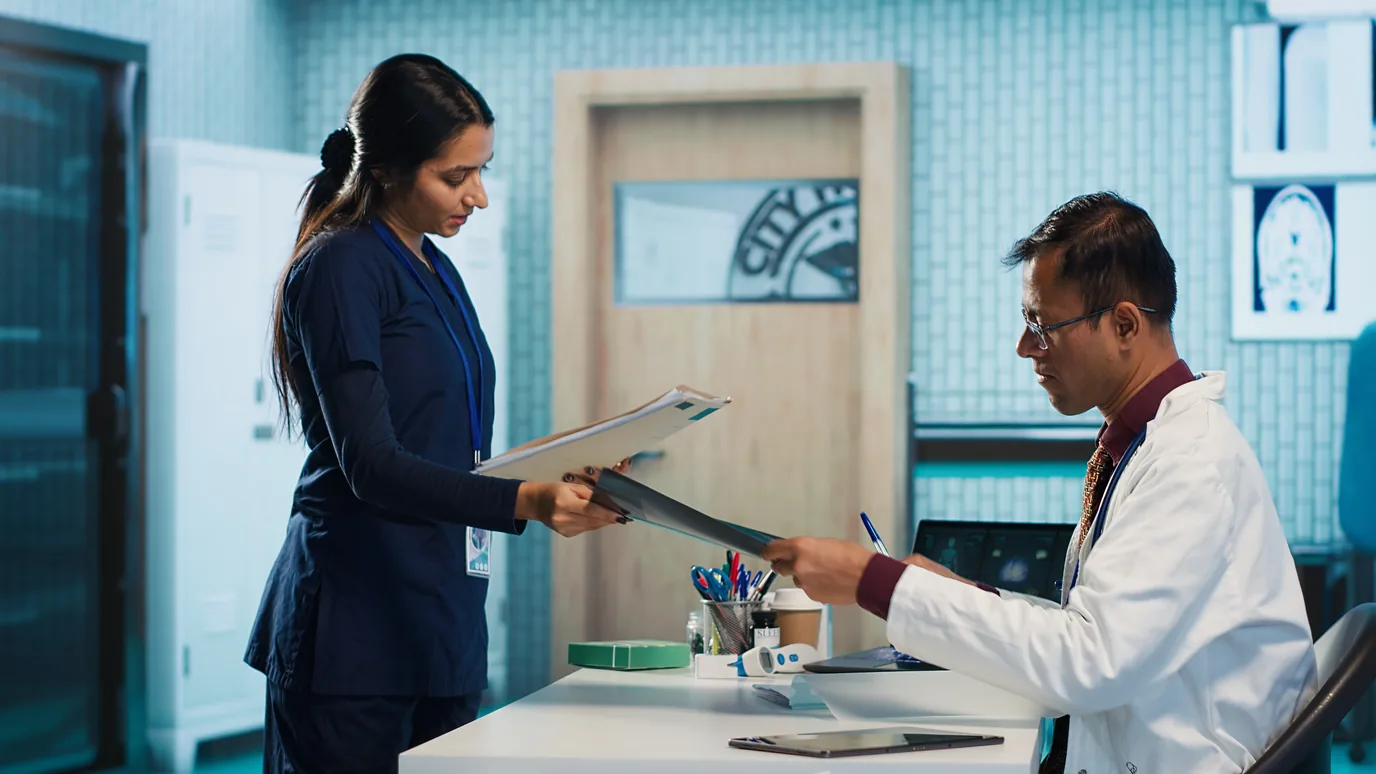
Diagnosis begins with a conversation and an examination. I ask when the curve was noticed, whether it is worsening, and about pain, falls, fever or weight loss. I check whether the curve straightens when you stand tall or lie flat, which points towards posture, or stays rigid, which points towards a change in the bones. I also test the strength, sensation and reflexes in your arms and legs.
The tests that help are:
- Standing X-rays of the whole spine. The main test: they show the size of the curve, the shape of the vertebrae and overall balance.
- MRI. Advised when there are nerve symptoms, pain at night, suspected infection or tumour, or a recent fracture.
- CT scan. Shows bone detail when surgery is being planned or a fracture is complex.
- Bone density (DEXA) scan. Measures bone strength in adults, especially when the kyphosis may be from osteoporosis.
- Blood tests. Helpful when infection, inflammation or another illness is suspected.
Treatment of kyphosis without surgery
Most people with kyphosis never need an operation. Treatment aims to ease pain, keep the spine strong and flexible, and stop the curve from worsening.
Posture work and exercise. For postural kyphosis, this is the main treatment: sitting and standing tall, keeping your desk and phone at eye level, and strengthening the upper back. Useful exercises include gentle back extensions lying on your stomach, shoulder-blade squeezes, chest stretches in a doorway, and stretches for tight hamstrings and hip muscles. Walking, swimming and yoga under good guidance all help.
Physiotherapy. A physiotherapist can match a programme to your type of kyphosis and progress it over time. For older adults, balance training also lowers the risk of falls.
Treating osteoporosis. When kyphosis comes from weak bones, preventing the next fracture is the most important step: a bone density test, calcium and vitamin D, bone-strengthening medicines when your doctor advises them, safe exercise and fall prevention at home.
Bracing in growing children. A child with Scheuermann's kyphosis who is still growing may be advised a brace, which can stop the curve from worsening while the spine grows. It does not help adults.
Pain relief. Short courses of simple painkillers chosen by your doctor, heat and activity changes ease flare-ups and help you stay active, which is what helps the spine most.
Treating the cause. Kyphosis from spinal TB needs a full course of anti-TB medicines, and kyphosis from a tumour needs treatment of the tumour, with the spine watched closely.
When kyphosis needs surgery
Surgery is considered only for a small group of people. The usual reasons are:
- pressure on the spinal cord or nerves, causing weakness, numbness, unsteady walking or bladder changes,
- constant, severe pain that has not improved with proper non-surgical care,
- a large or worsening deformity that affects standing, walking, looking ahead, breathing or quality of life,
- an unstable spine after a fracture, infection or tumour.
The main operations are:
- Spinal fusion with screws and rods. The curve is corrected and held while the vertebrae heal into one solid bone.
- Osteotomy. For stiff curves, the surgeon carefully removes and reshapes a small part of the bone so the spine can be brought into a better position, and then fuses it.
- Kyphoplasty or vertebroplasty. For a painful recent osteoporotic fracture, bone cement is placed into the broken vertebra through a needle. In kyphoplasty, a small balloon first restores some of the height. These are minimally invasive procedures. Read more about kyphoplasty and vertebroplasty.
As a deformity spine surgeon, I plan every correction from full-length X-rays, CT and MRI and a check of bone strength and general health. It can be a major operation, so the decision is made with the patient and family after other options are discussed. Our page on deformity corrections describes these treatments.
Living with kyphosis: lifelong monitoring
A teenager's curve can change during growth, and an older adult's with each new osteoporotic fracture, so kyphosis is watched over the years. I usually suggest:
- regular follow-up with standing X-rays, as advised, especially in growing children,
- a daily exercise habit for the back and core muscles,
- repeat bone density checks and steady osteoporosis treatment in older adults,
- reporting any new pain, change in shape or nerve symptoms promptly,
- keeping a healthy weight and not smoking, which protects both bones and discs.
When to see a spine surgeon
Please book a consultation if:
- you or your family notice that your back is becoming more rounded,
- your child has a rounded back that does not straighten when standing tall,
- upper back pain lasts more than a few weeks or keeps returning,
- you are an older adult with sudden back pain after a minor fall, cough or lift,
- you are losing height or your clothes fit differently across the back.
Go to an emergency department straight away if kyphosis or back pain comes with weakness in the legs, numbness, unsteady walking, numbness in the private-part area, or changes in bladder or bowel control. Fever, night sweats or weight loss with back pain also need urgent tests.
I see patients from all over Hyderabad, Telangana and Andhra Pradesh. You can meet me at CARE Hospitals, HITEC City or DIA Clinics, Kokapet, or book a consultation.
Frequently asked questions
What is kyphosis? Kyphosis is an excessive forward rounding of the upper back, which can come from posture, wedge-shaped vertebrae, fractures, wear, infection or other conditions.
Can kyphosis be corrected with exercise? Postural kyphosis often improves well with posture work and exercise, while kyphosis from changed bones is controlled with exercise but not fully straightened.
Is kyphosis serious? Most kyphosis is mild and managed without surgery, but a large, worsening or painful curve, or one with nerve symptoms, needs a specialist assessment.
Does kyphosis from osteoporosis keep getting worse? It can, with each new spinal fracture, which is why treating the osteoporosis and preventing falls matters so much.
Who should I see for kyphosis in Hyderabad? A spine surgeon with deformity training, such as Dr. Praveen Goparaju, can find the cause of the curve and explain whether exercise, bracing or surgery suits you.