

"Sit straight!" is something many teenagers in Hyderabad hear every day at home and in school. Usually a rounded back is just a slouching habit. But in some young people, the back stays rounded however hard they try, because the bones of the spine have grown into a different shape. This is called Scheuermann's kyphosis. I am Dr. Praveen Goparaju, a spine surgeon who treats spinal deformity in children and adults, and in this article I explain how Scheuermann's kyphosis differs from bad posture, how it is found, and why treating it while a child is still growing makes such a difference.
What is Scheuermann's kyphosis?
Seen from the side, every upper back has a gentle outward curve. In Scheuermann's kyphosis, named after the Danish doctor who described it, this curve becomes larger and stiffer than normal.
The key change is in the vertebrae, the bony blocks of the spine. Normally each is shaped roughly like a box. In Scheuermann's kyphosis, the front of several vertebrae grows more slowly than the back during the growth spurt. The bones become wedge-shaped, thinner in front and taller behind. When three or more wedge-shaped vertebrae sit one above the other, the spine bends forward into a rounded hump.
Most often this happens in the middle of the upper back. Less often, it affects the junction between the upper and lower back, or the lower back itself, where it tends to cause more pain and less visible rounding.
Who gets it and why
Scheuermann's kyphosis usually shows up between about ten and fifteen years of age, around the pre-teen and early teen growth spurt. It is often noticed by a parent, a teacher or a sports coach, or in a school photograph. Boys seem to be affected a little more often than girls, but girls get it too.
The exact cause is not fully understood. What we do know is:
- it tends to run in families, so genes play a part,
- it develops during fast growth, when the growth plates of the vertebrae are most active,
- it is not caused by carrying a heavy school bag, sitting badly or anything the child or parents did wrong.
That matters, because many teenagers are scolded for "slouching" for years before the real cause is found.
Scheuermann's kyphosis or just bad posture?
This is the question I am asked most often. Both can look similar at first glance, but they behave very differently.
| Postural rounding | Scheuermann's kyphosis | |
|---|---|---|
| Shape of the curve | Smooth and gentle | Sharper, sometimes angled at one spot |
| Standing tall | The back straightens | The rounding stays |
| Lying flat on the back | The curve flattens | The curve stays stiff |
| Bending forward, seen from the side | Smooth, even curve | A clear hump, often at the peak of the curve |
| Bones on X-ray | Normal box-shaped vertebrae | Several wedge-shaped vertebrae with irregular edges |
| Pain | Usually little or none | Sometimes, especially with activity |
A simple check at home: ask your child to stand against a wall and pull the shoulders back, then to lie flat on the floor. If the upper back stays clearly rounded and stiff, it is worth getting it examined.
Signs and symptoms of Scheuermann's kyphosis
The signs to watch for are:
- a rounded upper back that does not straighten when the child stands tall,
- shoulders that roll forward and a head that pokes ahead of the body,
- an increased inward curve of the lower back below the hump, as the body tries to balance,
- tight muscles at the back of the thighs, so that touching the toes is difficult,
- back pain in some teenagers, usually around the curve, worse with sports, long standing or long sitting, and better with rest,
- tiredness of the back muscles at the end of a school day.
Many teenagers have no pain, and the shape is the only concern. Some feel self-conscious and avoid certain clothes or sports, and this emotional side deserves attention too.
Rarely, a large and sharp curve can press on the spinal cord, causing numbness, weakness or clumsiness in the legs. Very large curves can occasionally affect breathing. These are uncommon but need a prompt assessment.
How Scheuermann's kyphosis is diagnosed
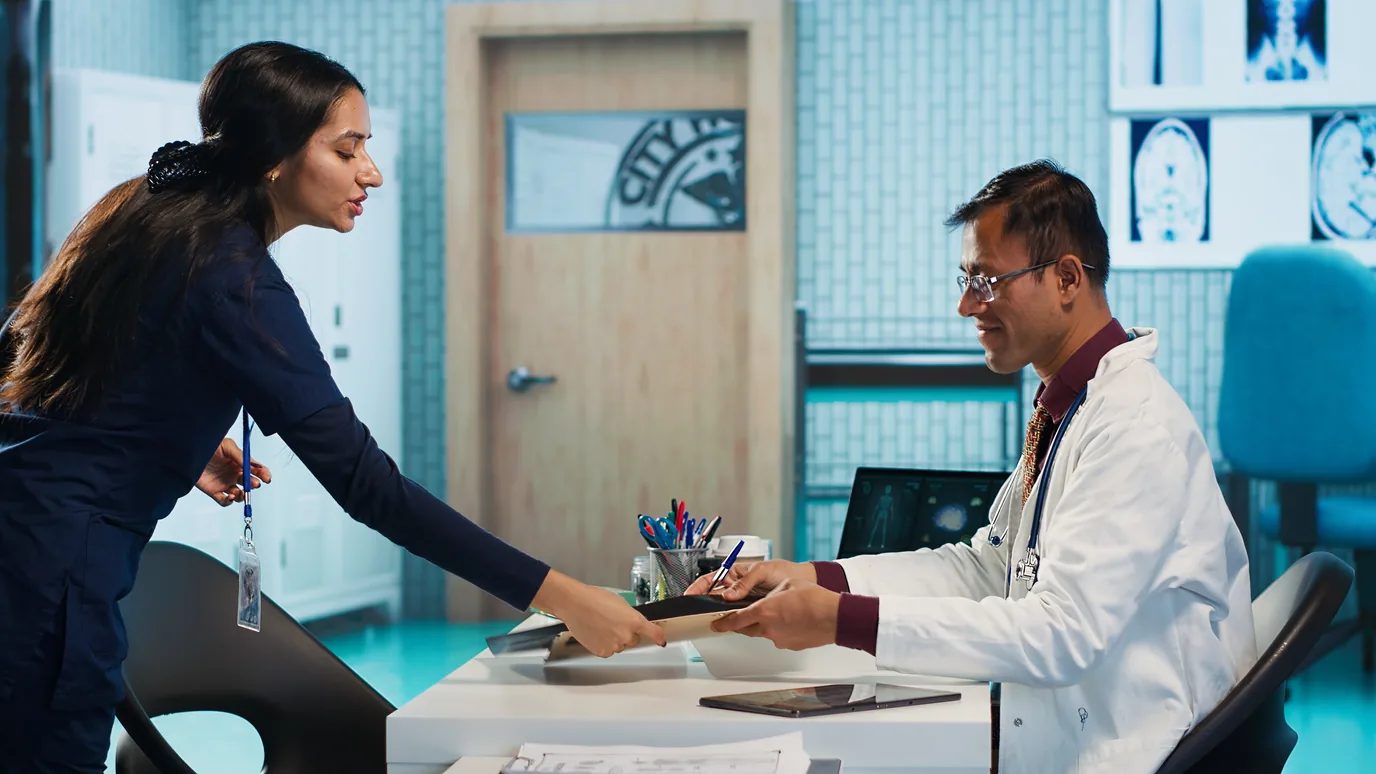
I ask when the rounding was noticed, whether it is worsening, about pain, and whether anyone in the family has a similar back. Then I examine the spine from the side and from behind, ask the child to bend forward, lie flat and arch backwards, and check the hamstrings, the nerves in the legs and the overall balance.
The main test is a standing side X-ray of the spine. It shows the size of the curve as an angle, the wedge shape of the vertebrae, and small irregularities at the edges of the bones that are typical of this condition. A front view also checks for a sideways curve, which is sometimes present as well. Because the bones are still growing, the X-ray also helps judge how much growth is left.
An MRI is advised only when there are nerve symptoms, unusual pain, or when surgery is being planned.
Treatment for Scheuermann's kyphosis
Treatment depends on three things: how large the curve is, how much growing the child still has to do, and whether there is pain. Most teenagers do well without surgery.
Observation. A mild curve without pain is usually watched with check-ups and X-rays at intervals during growth, to make sure it is not increasing.
Exercise and physiotherapy. This is part of every treatment plan. Exercises do not reshape the wedge-shaped bones, but they make a real difference to pain, posture, flexibility and confidence. A good programme includes:
- stretches for the hamstrings and the hip flexors at the front of the hips,
- back-extension exercises that strengthen the muscles along the spine,
- core and trunk strengthening for the abdomen and sides,
- chest stretches to open rounded shoulders,
- posture awareness for study, phone and laptop use.
Swimming, cycling and most sports are encouraged; only activities that clearly cause pain may need a short break.
Bracing while still growing. For a moderate curve in a child who still has growth left, a brace can stop the kyphosis from getting worse and may improve it a little. The brace is made to measure and is usually worn for many hours a day until growth is nearly complete. It works only while the spine is still growing, which is why the timing matters so much. Children who wear the brace as advised, and keep up their exercises, get the most from it. A brace does not help once growth has finished.
Pain relief. When the back aches, rest from the activity that triggers it, heat and short courses of simple painkillers chosen by your doctor usually help. Pain relief should support exercise, not replace it.
When surgery is considered
Surgery is needed only for a small number of young people. It is considered when:
- the curve is very large and keeps getting worse,
- there is constant pain that has not improved despite proper non-surgical care,
- there are nerve problems from pressure on the spinal cord,
- rarely, breathing is affected, or the deformity seriously affects daily life.
The operation is a spinal fusion. Working from the back, screws and rods are used to correct the curve gradually, and small amounts of bone are sometimes released or reshaped so the spine can straighten. The corrected vertebrae then heal into one solid bone over the following months. Our spinal fusion surgery guide explains fusion and recovery in more detail, and our page on deformity corrections describes how curves are planned and corrected.
This decision is taken carefully, after full-length X-rays and an MRI, together with the teenager and family.
Why treating it before growth finishes matters
The growing years are a window. While a child is still growing, the curve can increase, but it can also be guided. Exercise and, when needed, a brace do their work during this window. Once growth has finished, the shape of the bones is set. The curve rarely worsens much after that, but non-surgical treatment can no longer change it.
This is why a rounded back in a ten to fourteen year old should not be dismissed as a posture habit. An early check-up can save years of pain or a bigger treatment later.
Adults who had Scheuermann's kyphosis as teenagers usually lead full, active lives; a few develop aches or wear later and benefit from a review.
Scheuermann's kyphosis is a different condition from scoliosis, which is a sideways curve. If your child's back curves to one side, read our article on scoliosis surgery in Hyderabad.
When to see a spine surgeon
Please book a consultation if:
- your child's upper back stays rounded even when standing tall or lying flat,
- the rounding seems to be increasing during a growth spurt,
- your teenager has back pain that keeps returning, especially with sports,
- there is a family history of a rounded back and your child's back looks similar,
- your child is unhappy or anxious about the shape of the back.
Go to an emergency department straight away if back pain or a rounded back comes with weakness, numbness or clumsiness in the legs, unsteady walking, numbness in the private-part area, or changes in bladder or bowel control.
I see children, teenagers and adults from all over Hyderabad, Telangana and Andhra Pradesh. You can meet me at CARE Hospitals, HITEC City or DIA Clinics, Kokapet, or book a consultation.
Frequently asked questions
What is Scheuermann's kyphosis? It is a stiff, rounded upper back that develops during the growth spurt, when several vertebrae grow into a wedge shape.
Is Scheuermann's kyphosis caused by bad posture? No, the bones themselves change shape during growth, although good posture and exercise help ease the symptoms.
Can Scheuermann's kyphosis be corrected without surgery? Exercise and, in growing children, a brace can stop it worsening and ease pain, and most teenagers never need surgery.
Can my child play sports with Scheuermann's kyphosis? Yes, most sports are encouraged, and only activities that clearly trigger pain may need a short break.
Who should check my child's rounded back in Hyderabad? A spine surgeon with training in spinal deformity, such as Dr. Praveen Goparaju, can examine your child, review the X-rays and plan the right treatment.