

When an MRI report says "disc prolapse" or "disc herniation", the next question is almost always the same: what now? One relative says rest in bed for a month, a colleague swears by an injection, and someone else has already heard the word "surgery". It is easy to feel lost. I am Dr. Praveen Goparaju, a spine surgeon in Hyderabad, and in this article I want to walk you through slip disc treatment in Hyderabad the way I explain it to patients in my clinic: the full ladder of options, from simple changes in daily activity to keyhole surgery, and how we decide which step is right for you.
A quick word on what a slip disc is
Each disc between the bones (vertebrae) of your spine has a tough outer ring and a soft, jelly-like centre. With strain, wear or a sudden awkward lift, the ring can tear and part of the centre can push out. Nothing actually "slips", but that is the common name.
Pain starts when the pushed-out part presses on a nearby nerve: down the leg (sciatica) from the lower back, or into the arm from the neck. Treatment aims to calm that nerve and give the disc time to settle. Only when that fails, or the nerve starts to lose function, does removing the fragment become the better choice.
Step 1: Staying active, the right way
For many years people with a slip disc were told to lie flat for weeks. We now know that long bed rest weakens the back muscles, stiffens the joints and often slows recovery.
What helps more is what doctors call relative rest:
- take it easy for a day or two when the pain is at its worst,
- start short, frequent walks as soon as you can manage them,
- avoid heavy lifting, long sitting and bending forward under a load for a few weeks,
- change position often instead of sitting through a long meeting or a long drive in city traffic,
- sleep on your side with a pillow between the knees, or on your back with a pillow under the knees.
Many people notice their leg or arm pain beginning to ease over a few weeks with these changes and simple pain relief alone.
Step 2: Medicines to calm the pain
Medicines do not repair the disc, but they make the early weeks bearable so that you can keep moving. Depending on your age and general health, your doctor may suggest:
- anti-inflammatory painkillers, which reduce swelling around the nerve,
- nerve-pain medicines, which calm burning, shooting or tingling pain,
- muscle relaxants for a short time, when the back muscles are in spasm.
Take these only as prescribed and for the shortest time needed. Painkillers taken for months without advice can harm the stomach and kidneys, especially in people with diabetes or high blood pressure.
Step 3: Physiotherapy
Once the sharpest pain has settled, physiotherapy becomes the backbone of treatment. A good physiotherapist will:
- teach you positions and movements that take pressure off the nerve,
- gently bring back movement in the lower back or neck,
- build strength in the deep core and back muscles that support the spine,
- correct the way you sit, stand, lift and work at a desk.
Machines and hot packs can feel soothing, but the exercises you keep doing at home matter far more.
Step 4: Nerve root block and other injections
If leg or arm pain stays severe despite a few weeks of medicines and exercise, an injection can help. In a nerve root block, a fine needle is guided with live X-ray to the exact nerve that is irritated, and medicine that reduces inflammation is placed around it. It is a short day-care procedure, usually done under local anaesthetic.
An injection does not remove the disc, but it can calm the nerve enough for you to walk, sleep and exercise while the disc heals naturally. It also helps confirm which nerve is involved. For some people it is the turning point; for others the relief is temporary. You can read more on our pain management page.
Step 5: Endoscopic discectomy (keyhole surgery)
When pain or weakness continues despite proper non-surgical care, or when the nerve is clearly being damaged, an operation to remove the disc fragment is considered.
In endoscopic discectomy, the surgeon makes a very small cut, often around a centimetre, and passes a thin tube carrying a camera (an endoscope) down to the disc. The fragment pressing on the nerve is removed while the back muscles are gently moved aside rather than cut. Most people walk within hours and go home within a day or so. It suits many, but not all, types of disc herniation; the size and position of the fragment on the MRI decide this.
Step 6: Microdiscectomy
Microdiscectomy does the same job, removing the part of the disc that presses on the nerve, using an operating microscope through a small cut in the back. It has been used for decades and works well for a wide range of disc herniations, including some that are difficult to reach with an endoscope. Recovery is also quick, and most people walk the same day or the next.
Endoscopic and microscopic surgery are both minimally invasive. Our article on keyhole vs open spine surgery explains the differences between the approaches in more detail.
Step 7: Fusion or disc replacement (rarely needed)
Most people with a slip disc never need more than a discectomy. Larger operations are kept for special situations:
- Spinal fusion joins two vertebrae so that they heal into one bone. It may be needed when the disc has collapsed badly, the segment is unstable, a vertebra has slipped forward along with the disc problem, or the disc has herniated repeatedly at the same level.
- Disc replacement removes the damaged disc and puts in an artificial one that keeps movement. It is used most often in the neck for arm pain caused by a disc, and in carefully selected patients in the lower back.
Comparing slip disc treatment options
| Option | What it does | Usually suited to |
|---|---|---|
| Staying active and walking | Lets the disc settle while keeping muscles working | Almost everyone, from the first days |
| Medicines | Calm pain and inflammation around the nerve | The painful early weeks |
| Physiotherapy | Restores movement and builds support for the spine | Most people once the sharp pain eases |
| Nerve root block | Places anti-inflammatory medicine at the irritated nerve | Severe leg or arm pain that is not settling |
| Endoscopic discectomy | Removes the fragment through a keyhole cut with a camera | Lasting pain or weakness, disc in a suitable position |
| Microdiscectomy | Removes the fragment through a small cut with a microscope | Lasting pain or weakness, wide range of disc types |
| Fusion or disc replacement | Steadies or replaces the whole disc | Instability, a collapsed disc, repeat herniation |
Slip disc treatment in Hyderabad: how the choice is made
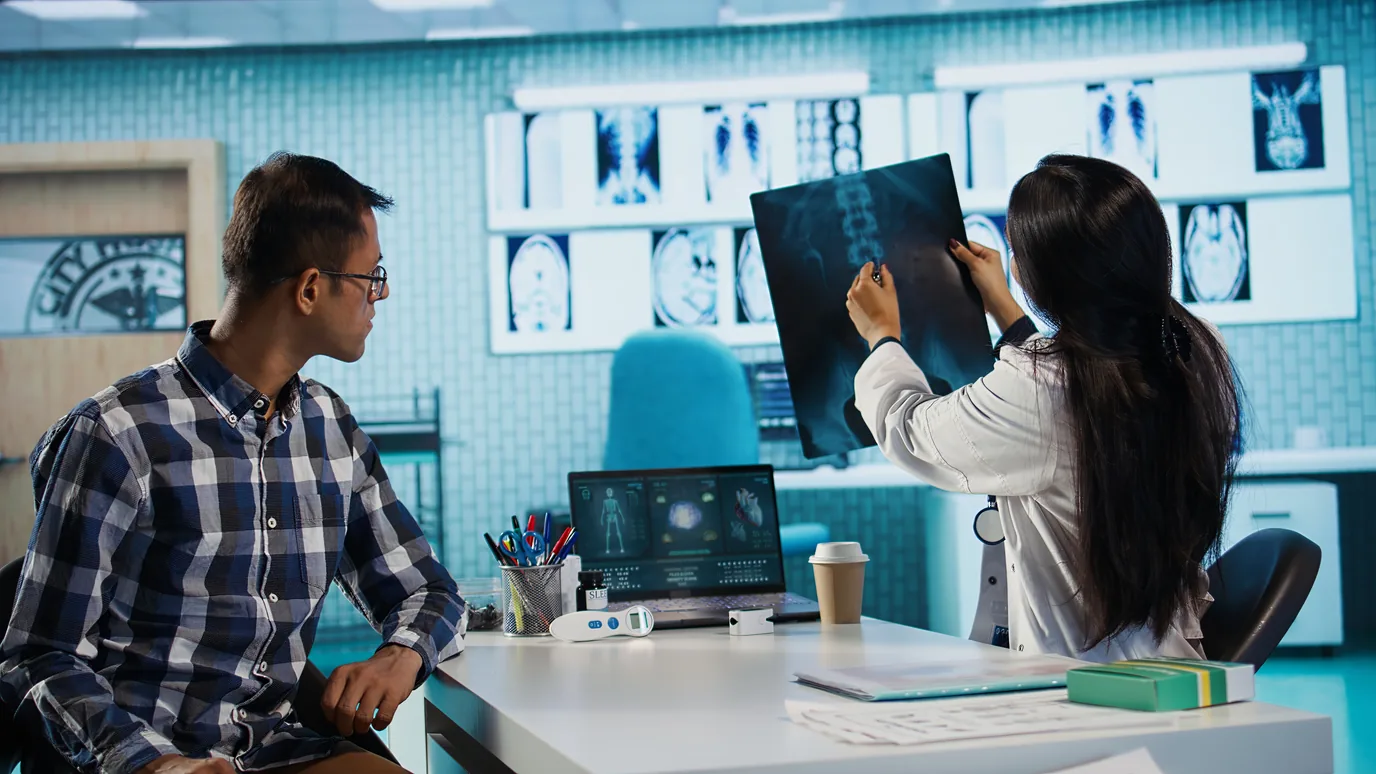
No two slip discs are the same, and the MRI alone never decides the treatment. A large disc on the scan with mild symptoms may settle on its own, while a small one sitting right on a nerve can cause severe pain. When I plan treatment, I look at five things:
- Your symptoms. How bad is the leg or arm pain compared with the back or neck pain? Is it getting better, staying the same or getting worse?
- The examination. Testing strength, sensation and reflexes shows whether the nerve is only irritated or is beginning to lose function.
- The MRI. It shows which disc and which nerve are involved, and the size and position of the fragment. This matters when choosing between endoscopic surgery and microdiscectomy.
- Time. Many disc herniations shrink over weeks to months. If you are steadily improving, it is usually worth giving your body more time.
- Your life. Your work, family duties, travel, other conditions such as diabetes or heart disease, and your own wishes all shape the plan.
In general, non-surgical care comes first. Surgery moves earlier in the plan when weakness is increasing (for example a foot that drags or slaps on the floor), when severe pain has not settled after several weeks of proper treatment, or when red-flag signs appear. Our disc surgeries page describes each of these procedures.
When to see a spine surgeon
Please book a consultation if:
- leg or arm pain has not improved after four to six weeks,
- pain wakes you at night or stops you from working,
- numbness or tingling is spreading,
- you notice weakness in a leg, foot, arm or hand,
- you have been told you need surgery and want to understand all your choices.
Go to an emergency department straight away if you have numbness around the private parts or buttocks, new difficulty passing urine or controlling the bladder or bowels, or weakness in both legs. These can be signs of severe pressure on the nerves that needs urgent treatment.
I see patients from all over Hyderabad, Telangana and Andhra Pradesh. You can meet me at CARE Hospitals, HITEC City or DIA Clinics, Kokapet, or book a consultation.
Frequently asked questions
Where can I get slip disc treatment in Hyderabad? Dr. Praveen Goparaju, a spine surgeon, offers the full range of slip disc treatment in Hyderabad at CARE Hospitals, HITEC City and DIA Clinics, Kokapet, from exercise plans to keyhole surgery.
Does every slip disc need surgery? No, most improve with activity, short courses of medicine, physiotherapy and sometimes an injection; surgery is for lasting pain, weakness or red-flag signs.
Is a nerve root block a permanent cure? It does not remove the disc, but by calming the nerve it can let the pain settle while the disc heals on its own.
Which is better, endoscopic discectomy or microdiscectomy? Both remove the disc fragment through a small cut, and the choice depends on the size and position of the disc on your MRI.
How soon can I walk after slip disc surgery? Most people walk within hours of endoscopic surgery and on the same or next day after a microdiscectomy.