

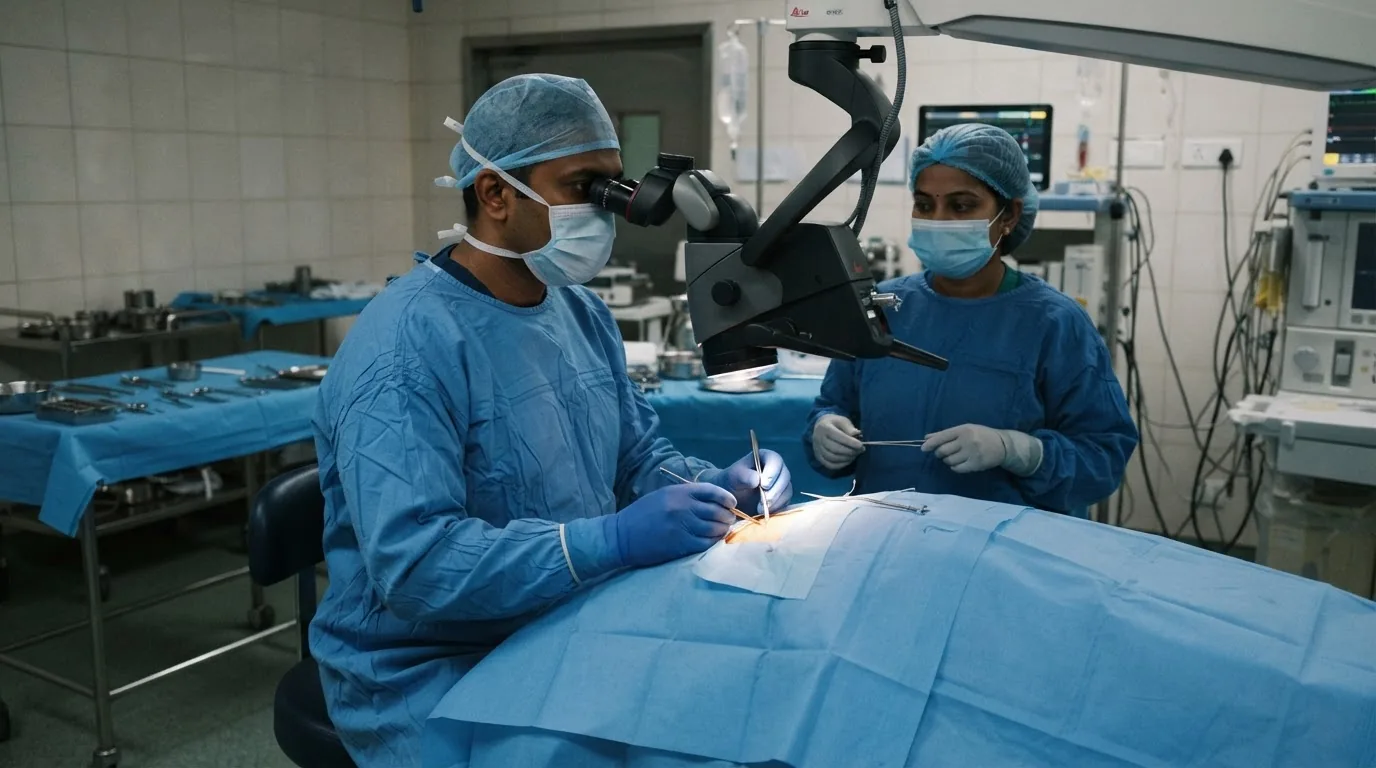
When a patient in Hyderabad is told they may need spine surgery, the first question is often: "Can it be done by keyhole?" As a spine surgeon, I hear this every week at CARE Hospitals, HITEC City and at our Kokapet clinic. Keyhole surgery sounds smaller and safer, and for the right person it often is. But it is not the right answer for every spine.
This article explains, in simple words, what keyhole and open spine surgery mean, how they differ, and how your surgeon decides which one suits you.
What is keyhole spine surgery?
Keyhole spine surgery is also called minimally invasive spine surgery (MISS). The surgeon works through one or more small cuts in the skin, often about the size of a fingertip or smaller, instead of one long opening.
Through these small openings the surgeon uses:
- an operating microscope, which magnifies the area many times, or
- an endoscope, a thin tube with a camera and light, which shows a clear picture on a screen, and
- narrow tubes that gently push the back muscles apart instead of cutting them away from the bone.
Because the muscles are spread rather than stripped, there is usually less damage to the healthy tissue around the spine. You can read more about one type of keyhole surgery in our article on endoscopic spine surgery.
What is open spine surgery?
In open surgery, the surgeon makes a longer cut and moves the back muscles aside to see the spine directly. This gives a wide view of several levels at once and room to place screws, rods or cages where they are needed.
Open surgery is not "old-fashioned". It is still the right choice for many problems, especially when the spine needs to be straightened, stabilised over several levels, or rebuilt after a fracture, infection or tumour.
Keyhole and open surgery side by side
| Keyhole (minimally invasive) | Open surgery | |
|---|---|---|
| Skin cut | Small, often one or more cuts of 1-2 cm | Longer cut along the back or neck |
| Muscles | Gently spread apart | Moved aside from the bone |
| View | Magnified through microscope or camera | Direct, wide view of several levels |
| Blood loss | Usually less | Usually more |
| Pain after surgery | Often less | Often more in the first weeks |
| Hospital stay | Often shorter | Often longer |
| Usually suited to | Many single-level disc and nerve problems | Deformity, instability, multi-level disease |
These are general patterns. Every patient's recovery depends on their condition, age, general health and the exact operation.
Why smaller cuts can mean faster recovery

With keyhole surgery, many patients:
- feel less wound pain in the first days,
- lose less blood during surgery,
- get out of bed and walk sooner, often the same day or the next day,
- go home earlier and return to desk work sooner.
The magnified view also helps the surgeon see the nerves clearly and work around them with care.
Not every spine problem can be treated with keyhole surgery
This is the part many people do not hear. The right spine surgery is not simply the one with the smallest cut. It is the one that correctly fixes the problem in your spine.
An open approach may be needed for:
- Spinal deformity, such as adult scoliosis or severe kyphosis, where the curve must be corrected. See adult spinal deformity surgery.
- Instability, where one vertebra slips or moves too much and needs a fusion with screws and rods. See spinal fusion surgery.
- Problems at many levels, where nerves are pressed at three, four or more places.
- Some fractures, infections and tumours, where the surgeon needs a wide view to clean, rebuild or support the spine.
Choosing keyhole surgery for a problem that needs an open operation can leave the real cause untreated, and the pain may return.
How your spine surgeon decides

The choice is based on your diagnosis, not on the size of the cut. Your surgeon will look at:
- Your symptoms: leg or arm pain, numbness, weakness, walking distance, bladder or bowel changes.
- The examination: reflexes, muscle strength, sensation and posture.
- Your scans: MRI to see discs and nerves, X-rays (often standing films) to check alignment and movement, and sometimes a CT scan for bone detail.
- Your general health: diabetes, heart problems, bone strength and other conditions.
Only when all four are put together can the surgeon say which approach will give you the most reliable result. Sometimes a mix is used, for example a fusion done through smaller cuts.
What recovery looks like
After keyhole disc surgery, most people walk within hours, go home within a day or two, and return to light desk work in a few weeks, as advised by their surgeon.
After open surgery or a fusion, the hospital stay is usually a few days. Walking starts early, and physiotherapy builds strength over the following weeks and months. Fusion bone takes several months to become solid.
In both cases, following your surgeon's advice on walking, lifting and sitting matters as much as the operation itself.
Common myths about keyhole spine surgery
"Keyhole surgery means no scar and no recovery." The scar is smaller, but healing still takes time. Deep tissues need weeks to settle, and you will still need to follow advice on bending, lifting and driving.
"If it is keyhole, anyone can have it." Suitability depends on the problem, not on the patient's wish. A condition that needs correction or fixation over several levels cannot be treated properly through a tiny opening.
"Open surgery means a long time in bed." Even after open surgery, most patients are helped to sit and walk within a day or two. Early movement is a key part of recovery.
"Keyhole surgery is always cheaper." Costs depend on the procedure, implants and hospital stay. Ask your surgeon's team for a clear estimate for your own operation.
When to see a spine surgeon
Most back and neck pain gets better without surgery. Please see a spine surgeon if you have:
- leg or arm pain that has not improved after about six weeks of proper care,
- pain that stops you from walking a normal distance,
- new numbness or tingling that is spreading.
Go to an emergency department straight away if you notice weakness in your legs, numbness around the private parts, or loss of control over urine or bowel movements. These can be signs of serious nerve pressure.
If you are in Hyderabad, you can meet me at CARE Hospitals, HITEC City or DIA Clinics, Kokapet, or book a consultation.
Frequently asked questions
Is keyhole spine surgery safer than open surgery? For suitable problems it often means less blood loss, less pain and a quicker recovery, but every operation has risks and the right choice depends on your diagnosis.
Can a slipped disc be treated by keyhole surgery? Many single-level slipped discs that need surgery can be treated through a keyhole approach, though most slipped discs get better without any operation.
Why did my surgeon advise open surgery? Deformity, instability or disease at several levels often needs the wider view and fixation that open surgery gives.
How long is the hospital stay after keyhole spine surgery? Many patients go home within one or two days, depending on the operation and their general health.
Who can explain which surgery is right for me? A qualified spine surgeon such as Dr. Praveen Goparaju in Hyderabad can review your symptoms, examination and scans together and explain your options.