

Few pains are as hard to ignore as sciatica. It can start as a dull ache in the buttock and turn into a sharp, electric pain that runs all the way to the foot, making it difficult to sit through a meal, ride a two-wheeler or sleep through the night. I am Dr. Praveen Goparaju, a spine surgeon in Hyderabad, and sciatica is one of the most common reasons people come to see me. In this guide to sciatica pain causes, symptoms and treatment, I explain where the pain comes from, how it feels, which tests actually help, how it is treated, and which warning signs mean you should not wait.
What sciatica really is
Sciatica is not a disease in itself. It is a name for a pattern of pain caused when one of the nerve roots in the lower back is pressed or irritated.
Several nerve roots leave the lower part of the spine and join together in the buttock to form the sciatic nerve, the longest nerve in the body. It runs down the back of the thigh and divides into branches that supply the calf, the ankle and the foot. When one of these roots is squeezed near the spine, the brain feels the pain along the path of the nerve, which is why a problem in the back is felt in the leg.
This is why many people with sciatica have little or no back pain and assume the problem is in the hip or calf.
Common causes of sciatica pain
Anything that narrows the space around a lower-back nerve root can cause sciatica. The common causes are:
- Slip disc (disc herniation). This is the most frequent cause, especially in people between their twenties and fifties. Part of the soft centre of a disc pushes out and presses on a nerve root. Lifting heavy loads while bent forward, long hours of sitting and sudden twisting can all trigger it.
- Lumbar canal stenosis. With age, discs wear, the small joints thicken and ligaments stiffen, so the canal for the nerves gradually narrows. This is more common after fifty, and the leg pain typically comes on with walking or standing and eases with sitting. Our page on spinal stenosis treatment explains this in detail.
- Spondylolisthesis. One vertebra slips forward over the one below and narrows the space for the nerve.
- Muscle-related causes. Rarely, a tight muscle deep in the buttock (the piriformis) irritates the sciatic nerve itself.
- Less common but serious causes. Spinal infection, including spinal tuberculosis, which we still see in India, a fracture, or a tumour can press on the nerves. These are rare, but they are the reason sciatica with fever, weight loss or severe night pain should always be checked.
Who is more likely to get sciatica?
Some everyday factors raise the risk:
- long hours of sitting at a desk or behind the wheel,
- riding a two-wheeler daily on rough or potholed roads,
- jobs that involve heavy lifting or repeated bending,
- weak core muscles and little regular exercise,
- being overweight,
- smoking, which reduces blood supply and nutrition to the discs,
- diabetes, which can make nerves more sensitive.
How sciatica pain feels
People describe sciatica in many ways, but certain features are typical:
- pain that starts in the lower back or buttock and runs down the back or side of the thigh, often past the knee into the calf or foot,
- an electric, shooting, burning or "toothache-like" quality to the pain,
- numbness, tingling or a pins-and-needles feeling in the leg or foot,
- pain that is usually on one side only,
- pain that gets worse on sitting, bending forward, coughing, sneezing or straining,
- in some people, weakness, such as difficulty standing on the toes or heels, or a foot that slaps on the floor while walking.
The exact area of numbness, for example the upper surface of the foot or the sole, tells the surgeon which nerve root is involved and where to look on the scan.
Conditions that can look like sciatica
Not all leg pain is sciatica. Hip arthritis causes groin and thigh pain, diabetic nerve damage usually causes burning in both feet, and poor circulation causes calf cramps on walking. A careful examination separates these from true sciatica, which is why I never treat leg pain on an MRI alone.
How sciatica is diagnosed
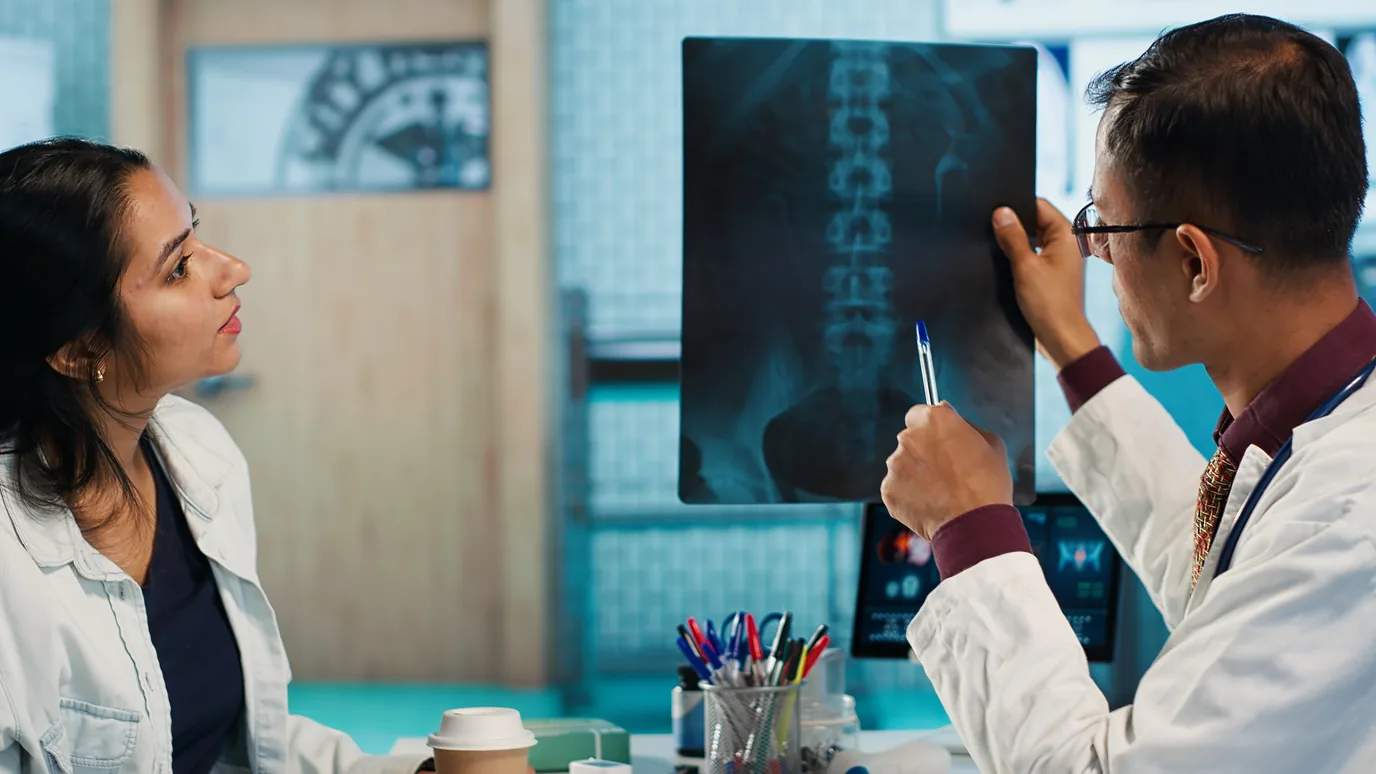
The most important test is a careful conversation and examination. I ask how the pain started, how far it travels, what makes it better or worse, and whether there are any warning signs. Then I check strength, sensation and reflexes in both legs. A simple test, in which the straight leg is lifted while you lie on your back, often reproduces the leg pain when a nerve root is irritated.
Scans are useful, but only at the right time:
- MRI of the lower back shows discs, nerves and the spinal canal clearly. It is advised when pain is severe, does not settle after a few weeks, or comes with weakness or red-flag signs.
- X-rays, sometimes taken while bending forward and backward, show alignment and whether a vertebra is slipping or moving abnormally.
- Nerve conduction studies are needed only in some cases, for example to tell sciatica apart from diabetic nerve damage.
- Blood tests are added when infection or another illness is suspected.
Sciatica pain causes, symptoms and treatment at a glance
| Cause | Usual age group | Typical symptoms | Usual treatment |
|---|---|---|---|
| Slip disc | Twenties to fifties | Sharp leg pain, worse on sitting and bending | Activity, physiotherapy, injection; discectomy if it persists |
| Lumbar canal stenosis | Over fifty | Leg pain or heaviness on walking, eases on sitting | Physiotherapy, injection; decompression if walking keeps reducing |
| Spondylolisthesis | Any age, more common later | Back pain with one- or two-sided leg pain | Core strengthening, injection; decompression with fusion if needed |
| Piriformis irritation | Any age | Buttock pain, worse on sitting, normal scan | Stretching and physiotherapy |
| Infection, fracture or tumour | Any age | Constant pain, night pain, fever or weight loss | Urgent evaluation and treatment of the cause |
How sciatica is treated
The good news is that most sciatica settles within a few weeks to a few months without surgery. Treatment usually follows these steps:
- Stay gently active. Short, frequent walks help more than lying in bed. Avoid heavy lifting and long sitting for a while.
- Medicines for a short time. Anti-inflammatory painkillers and nerve-pain medicines can make the early weeks bearable. They should be taken only as prescribed, never long term on your own.
- Physiotherapy. Exercises that ease pressure on the nerve, then strengthen the core and back muscles, form the main treatment once the sharp pain eases.
- Nerve root block. If leg pain stays severe, an injection placed near the irritated nerve under X-ray guidance can calm the inflammation and help you get back to exercise.
- Surgery, when needed. If pain or weakness continues despite proper non-surgical care, or nerve damage is getting worse, surgery removes what is pressing on the nerve. For a slip disc this is an endoscopic (keyhole) discectomy or a microdiscectomy. For stenosis it is a decompression, and if the spine is also unstable, a decompression with fusion.
Our sciatica treatment page explains each of these options and when they are used.
Home care tips and common myths
A few practical points help many people:
- a warm pack on the lower back or buttock can ease muscle spasm,
- when sitting is painful, use a chair with good back support, keep your hips slightly higher than your knees and stand up often,
- avoid deep forward bending and lifting from the floor for some weeks,
- do not allow forceful massage, cracking or "disc setting" on an irritated back,
- belts may give comfort for a few days, but wearing them for weeks weakens the muscles.
Sciatica does not always mean surgery, but leg pain should not be ignored for months either.
Red flags you should never ignore
Some symptoms mean the nerves are under serious pressure or that there is another illness behind the pain. Our article on sciatica warning symptoms covers these in more depth. Seek care the same day if you notice:
- numbness around the private parts, inner thighs or buttocks,
- new difficulty passing urine, or loss of bladder or bowel control,
- weakness in both legs, or a leg that is quickly getting weaker,
- sciatica with fever, unexplained weight loss or a history of cancer,
- severe pain after a fall or accident.
When to see a spine surgeon
Please book a consultation if:
- leg pain has not improved after four to six weeks,
- pain wakes you at night or stops you from working,
- numbness or tingling is spreading,
- you notice weakness in the leg or foot, or your foot catches while walking,
- sciatica keeps coming back.
Go to an emergency department straight away if you have any of the red-flag signs above, especially numbness around the private parts or changes in bladder or bowel control.
I see patients from all over Hyderabad, Telangana and Andhra Pradesh. You can meet me at CARE Hospitals, HITEC City or DIA Clinics, Kokapet, or book a consultation.
Frequently asked questions
What are the main sciatica pain causes, symptoms and treatment options? The usual causes are a slip disc, canal narrowing or a slipped vertebra, the main symptom is pain down one leg, and most cases settle with activity, physiotherapy and sometimes an injection.
Can sciatica go away on its own? Yes, most sciatica improves within a few weeks to a few months, though an examination is still worth it to check the nerve.
Is walking good for sciatica? Yes, gentle, frequent walks usually help, while long bed rest tends to slow recovery.
Do I need an MRI for sciatica? Not always; an MRI is advised when pain is severe, lasts beyond a few weeks, or comes with weakness or warning signs.
When does sciatica need surgery? A spine surgeon such as Dr. Praveen Goparaju will consider surgery when leg pain or weakness continues despite proper non-surgical care, or when there are red-flag signs.