

Many people who come to my clinic with a cervical disc prolapse are surprised that their neck is not the worst part. What troubles them most is a sharp, burning pain running down one arm, a numb thumb, or a hand that suddenly feels weak while lifting a bag or riding a two-wheeler through Hyderabad traffic. I am Dr. Praveen Goparaju, a spine surgeon in Hyderabad, and in this article I explain what a cervical disc prolapse is, why it causes arm symptoms, how it is diagnosed, and why most people get better without an operation.
What is a cervical disc prolapse?
The neck has seven small bones called vertebrae, stacked one above the other. Between each pair sits a disc, a soft cushion that lets the neck bend and turn and absorbs the load of the head.
Each disc has two parts. The outer ring is tough and fibrous, a little like the layers of an onion. The centre is softer and jelly-like. When the outer ring develops a tear, some of the soft centre can push out through it. This is a prolapse, also called a herniated disc or, in everyday language, a "slip disc". The disc does not actually slip out of place; a part of it bulges or escapes backwards.
Behind the discs lie the spinal cord and the nerve roots that supply the shoulders, arms and hands. There is very little spare room here, so even a small piece of disc can press on a nerve root, and a larger one on the spinal cord itself.
Causes: wear over time or a sudden injury
Gradual wear (degeneration). From our thirties onwards, the discs slowly lose water and develop small cracks. Then an ordinary movement, such as turning the head sharply, sneezing or lifting a heavy suitcase, can push disc material through a weak spot. This is the more common story, and many people remember no particular injury.
Injury. A road accident, a fall or a sudden jerk of the neck can tear a disc that was otherwise healthy, more often in younger people.
Long hours bent over a laptop or phone, heavy or overhead work, smoking, a family tendency and earlier neck injuries all add to the load on the discs.
Symptoms: neck pain, arm pain, numbness and weakness
A cervical disc prolapse can cause neck pain and stiffness, often with pain over the shoulder blade. But the typical feature is pain that travels into the arm. Doctors call this cervical radiculopathy, meaning an irritated nerve root. The arm pain is often sharp, burning or electric, and may be worse when you look up or tilt your head towards the painful side. Many people find relief by resting the hand on the head, which takes some tension off the nerve.
Along with pain, you may notice:
- tingling or "pins and needles" in particular fingers,
- numbness over part of the hand or forearm,
- weakness when gripping, lifting the arm or straightening the elbow.
For more about this pattern, read our guide to neck pain radiating to the arm.
Which fingers point to which disc?
Each nerve root supplies its own strip of skin and its own muscles, so the pattern of your symptoms helps your doctor work out which disc is involved. The levels most often affected are C5-C6 and C6-C7.
| Disc level | Nerve usually affected | Where you may feel it | Muscles that may weaken |
|---|---|---|---|
| C4-C5 | C5 | Shoulder and outer upper arm | Lifting the arm out to the side |
| C5-C6 | C6 | Outer forearm, thumb and index finger | Bending the elbow, lifting the wrist |
| C6-C7 | C7 | Back of the arm and middle finger | Straightening the elbow |
| C7-T1 | C8 | Inner forearm, ring and little fingers | Grip and fine finger movements |
This is a general guide. Real patterns overlap, and a careful examination is more reliable than a chart.
When a disc presses on the spinal cord
Sometimes a large prolapse sits in the middle of the canal and presses on the spinal cord. This is called cervical myelopathy. There may be little pain; instead there are clumsy hands, trouble with buttons or handwriting, numbness in both hands, unsteady walking or heavy legs and, in advanced cases, bladder or bowel changes. Spinal cord pressure needs prompt attention, because damage to the cord may not fully recover once it has set in.
Diagnosis: MRI, CT and why the scan must match your symptoms
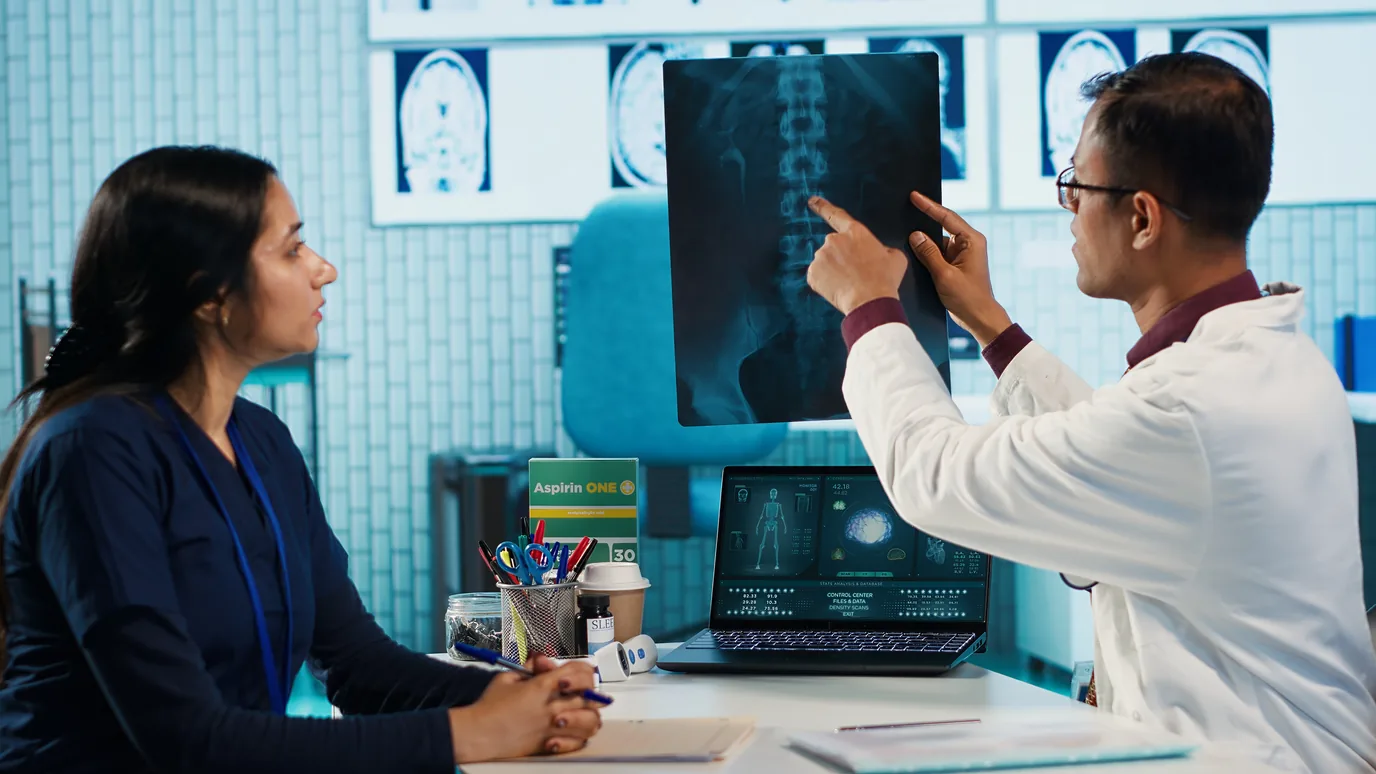
Diagnosis starts with a conversation and an examination of muscle strength, sensation in each finger, reflexes, and signs of spinal cord pressure such as brisk reflexes or poor balance.
MRI is the main scan, showing the discs, nerve roots and spinal cord without radiation. CT shows bone spurs in detail, or helps when MRI is not possible. X-rays show alignment and wear. Nerve conduction studies are sometimes added to rule out a nerve problem further down the arm, such as carpal tunnel syndrome.
One point I always explain: disc bulges are very common on MRI scans of people with no symptoms, especially after forty. A report full of "bulges" does not by itself mean you need treatment. What matters is whether the disc on the scan matches the nerve that your symptoms and examination point to.
Most people improve with time and physiotherapy
The encouraging news is that most cervical disc prolapses settle without surgery. The escaped disc material often shrinks as the body reabsorbs it, and the inflamed nerve calms down over weeks to months.
Treatment during this time aims to control pain and keep you moving:
- Stay gently active. Carry on with daily activities as far as pain allows, and avoid heavy lifting and long periods with the head bent.
- Medicines. Your doctor may suggest painkillers, anti-inflammatory tablets or medicines for nerve pain, chosen for your health, so please do not self-medicate.
- Physiotherapy. Posture correction, gentle movement and exercises for the deep neck and shoulder-blade muscles, increased step by step as pain settles.
- Work and posture changes. Raise your screen to eye level, take short breaks every half hour, and use a pillow that keeps your neck level.
- Heat or cold. A warm pack or a cold pack for short periods can ease muscle spasm.
Why long bed rest and traction are not advised
Many people in Telangana and Andhra are told to lie flat for weeks or take neck traction sessions. Long bed rest weakens muscles, stiffens the neck and slows recovery. Traction may give brief comfort, but it does not push a disc back and can be unsafe when the spinal cord is pressed. A soft collar may help for a few days of severe pain, but wearing it for weeks makes the neck stiffer.
Injections
If arm pain stays severe despite medicines and physiotherapy, an injection near the irritated nerve root, such as a nerve root block or epidural injection given under X-ray guidance, can calm the inflammation. It does not remove the disc, but it can ease pain enough for you to do your exercises while healing continues.
When is surgery needed for a cervical disc prolapse?
Surgery is advised for a minority of people, mainly when:
- there is pressure on the spinal cord (myelopathy),
- muscle weakness is significant or getting worse,
- severe arm pain continues for many weeks despite proper non-surgical care,
- pain is so severe that it cannot be controlled.
Surgery removes the disc material pressing on the nerve or cord. The main operations are:
- Anterior cervical discectomy and fusion (ACDF). Through a small cut at the front of the neck, the damaged disc is removed, the nerve and cord are freed, and a spacer is placed so the two vertebrae heal together as one.
- Cervical disc replacement. The disc is removed the same way, but an artificial disc is placed to keep movement at that level, for suitable patients. Read more about disc replacement surgery in Hyderabad.
- Posterior foraminotomy. Where suitable, for a fragment lying off to one side, the nerve's exit hole is widened through a small opening at the back of the neck, without a fusion.
Intraoperative neuromonitoring and navigation are used where suitable to help protect the nerves. Our page on lumbar and cervical disc surgeries gives more detail on each.
Recovery after surgery
Most people walk the same day and go home within a day or two. Arm pain often eases quickly, while numbness and weakness recover more slowly, over weeks to months. A short-lived sore throat or mild swallowing difficulty is common after front-of-neck surgery.
Desk work can often resume within a few weeks, heavier work later. Physiotherapy restores strength and posture, and follow-up X-rays check the healing.
When to see a spine surgeon
Please book a consultation if:
- arm pain, numbness or tingling lasts more than a few weeks,
- pain is so severe that it stops you sleeping or working,
- you notice weakness in your arm, hand or grip,
- you have both neck pain and clumsy hands or a change in your handwriting.
Go to an emergency department straight away if you develop weakness in the arms or legs, unsteady walking, numbness in the private-part area, or changes in bladder or bowel control.
I see patients from all over Hyderabad, Telangana and Andhra Pradesh. You can meet me at CARE Hospitals, HITEC City or DIA Clinics, Kokapet, or book a consultation.
Frequently asked questions
Can a cervical disc prolapse heal without surgery? Yes, most improve over weeks to months with time, medicines and physiotherapy, as the escaped disc material shrinks.
Which fingers go numb with a neck disc problem? It depends on the level: a C5-C6 disc often affects the thumb and index finger, and a C6-C7 disc the middle finger.
Is neck traction good for a slip disc in the neck? It does not push the disc back and can be unsafe if the spinal cord is pressed, so ask your doctor before trying it.
Do I need an MRI for arm pain from the neck? Not always at first, but an MRI is advised if pain lasts several weeks, is severe, or comes with weakness or clumsy hands.
Who should I see for a cervical disc prolapse in Hyderabad? A spine surgeon such as Dr. Praveen Goparaju can examine you, match your scan to your symptoms and plan the right treatment.