
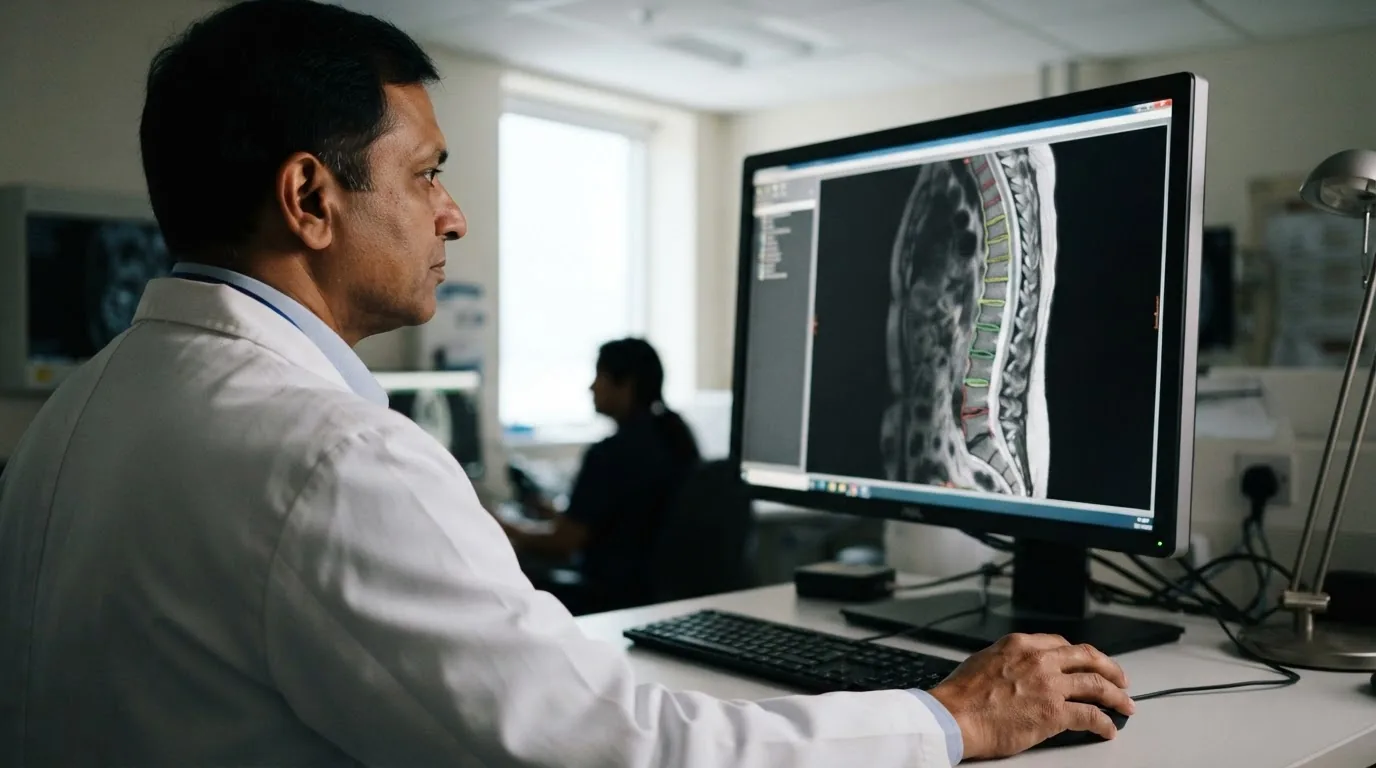
Today many patients in Hyderabad type their symptoms into an AI chatbot before they see a doctor. Some even upload their MRI report and ask, "Do I need surgery?" As a spine surgeon, I welcome curious patients. But I also want to explain clearly what AI and robotics can do in spine care, and what they still cannot.
Can AI replace spine surgeons?
The short answer is no. AI can scan images, sort information and help plan surgery. But treating a spine is not just about reading a scan. It is about understanding the person in front of you: their pain, their daily life, their other illnesses and what matters to them.
How AI is already helping spine care
Reading scans faster. Software can help highlight discs, nerves and bones on MRI and CT scans, measure angles, and flag areas a doctor should look at closely.
Planning surgery. Three-dimensional models built from scans help surgeons plan the size and path of screws, or how much correction a curved spine needs.
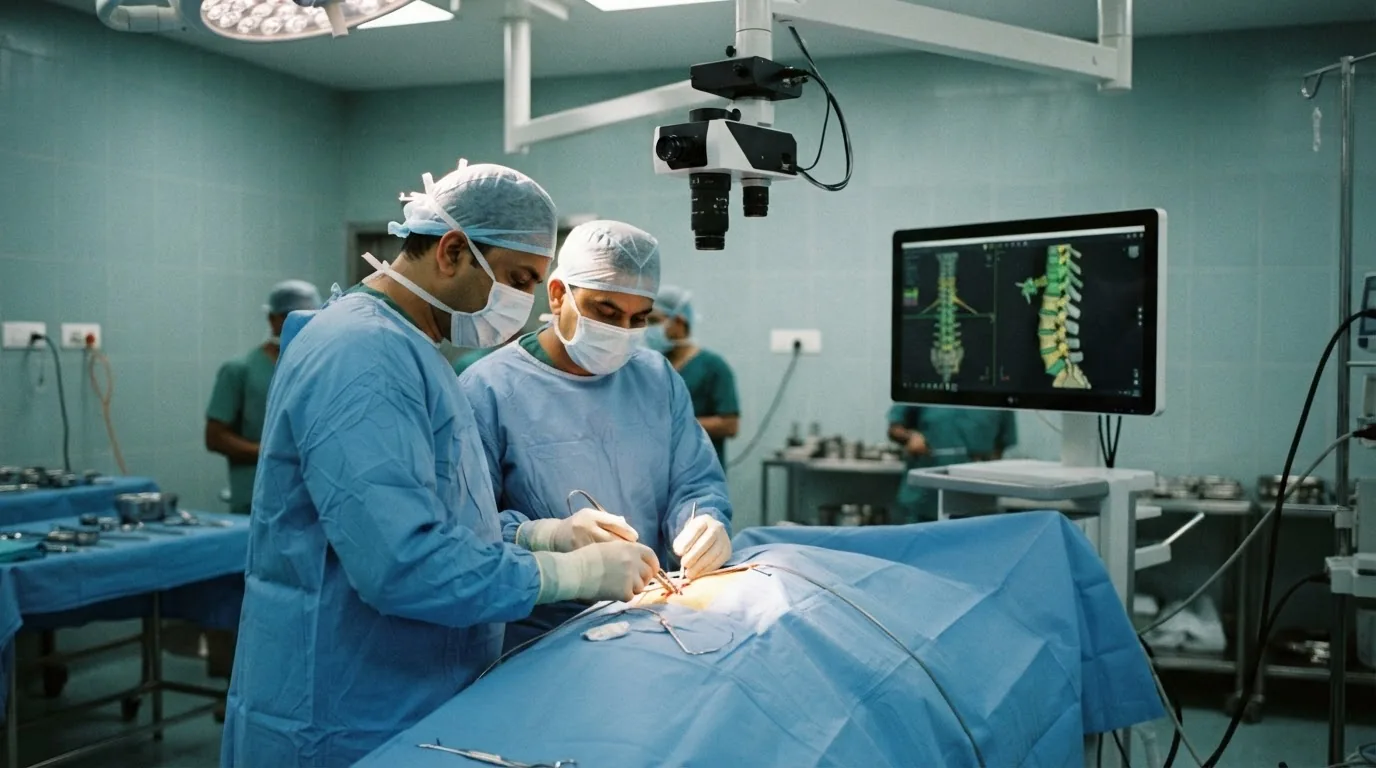
Navigation in the operating theatre. Surgical navigation works like a GPS for the spine. Cameras track instruments in real time against the patient's scan, helping the surgeon place implants with precision. Read more about spinal fusion surgery.
Robotics. In some hospitals, a robotic arm can hold a guide steady along the planned path while the surgeon does the operation. The robot does not decide or operate on its own; the surgeon controls every step.
Paperwork and follow-up. AI tools can help with reports, reminders and tracking recovery.
What AI cannot replace

| AI can | A spine surgeon also does |
|---|---|
| Find a disc bulge on an MRI | Decide whether that bulge actually explains your symptoms |
| Measure a curve or slip | Examine your strength, reflexes and walking |
| Suggest common treatments | Weigh your age, diabetes, heart health and bone strength |
| Answer general questions | Listen to your full medical history and your goals |
| Plan screw paths | Adapt in real time when surgery reveals something new |
Here is an important fact: many adults have disc bulges or wear on their MRI without any pain at all. A scan finding does not always mean it is the cause of your problem. Only an examination that matches your symptoms to your scan can tell.
Using AI safely as a patient
AI can be a good starting point to learn words like "disc bulge", "sciatica" or "spondylolisthesis". Use it to prepare questions for your doctor. But:
- Never treat an AI answer as a medical diagnosis.
- Do not start, stop or change medicines because a chatbot suggested it.
- Do not delay care for warning signs because an app said it is "probably muscular".
- Remember that AI tools can sound very confident even when they are wrong.
The future: doctors who use AI well
The future of spine surgery is not AI instead of surgeons; it is surgeons who use good tools well. Technology can improve accuracy and speed up planning. Judgement, examination, honest conversation and care still come from a trained human being.
Advances in minimally invasive and endoscopic surgery and in correcting adult spinal deformity have both been helped by better imaging and planning, but the decision about which surgery, if any, is right for you still rests on a careful diagnosis.
Questions to ask about technology before spine surgery
If your treatment involves imaging software, navigation or robotics, it is reasonable to ask:
- What exactly is my diagnosis, and how do my symptoms match my scan?
- Do I need surgery at all, or can I try other treatment first?
- How will this technology be used in my operation, and why?
- What will recovery look like for me, given my age and health?
- What are the risks, and what happens if something unexpected is found?
A good spine surgeon will answer these in simple words, without pressure, and will be comfortable telling you when technology adds little for your particular problem.
What a careful spine consultation includes
No app or algorithm can replace these steps:
- Listening. When did the pain start? Where does it travel? What makes it better or worse? How is it affecting your sleep, work and family life?
- Examining. Checking walking, posture, muscle strength, reflexes and sensation, and looking for warning signs.
- Matching. Comparing what is found on examination with what the MRI or X-ray shows, so that treatment targets the real cause.
- Explaining. Going through options from exercise and medicines to injections or surgery, along with their pros and cons.
- Deciding together. The final plan is made with you, not for you.
When to see a spine surgeon
See a spine specialist rather than relying on an app if you have:
- back or neck pain lasting more than a few weeks,
- pain going down an arm or leg, numbness or tingling,
- back pain that wakes you at night or comes with fever or weight loss.
Go to an emergency department straight away for new weakness in the legs or arms, numbness around the private parts, or loss of bladder or bowel control.
You can meet me at CARE Hospitals, HITEC City or DIA Clinics, Kokapet, or book a consultation.
Frequently asked questions
Can AI replace a spine surgeon? No. AI can help read scans and plan surgery, but it cannot examine you, understand your symptoms or make the final treatment decision.
Is robotic spine surgery done by a robot? No. The robotic arm only holds instruments steady along a planned path; the surgeon controls and performs the operation.
Can I use ChatGPT to understand my MRI report? It can explain terms, but never treat its answer as a diagnosis; discuss your report with your doctor.
Does a disc bulge on MRI always cause pain? No. Many people have disc bulges without pain, so the scan must be matched with your symptoms and examination.
Who can explain my spine scan in Hyderabad? A spine surgeon such as Dr. Praveen Goparaju can examine you and explain what your scan means for you.