




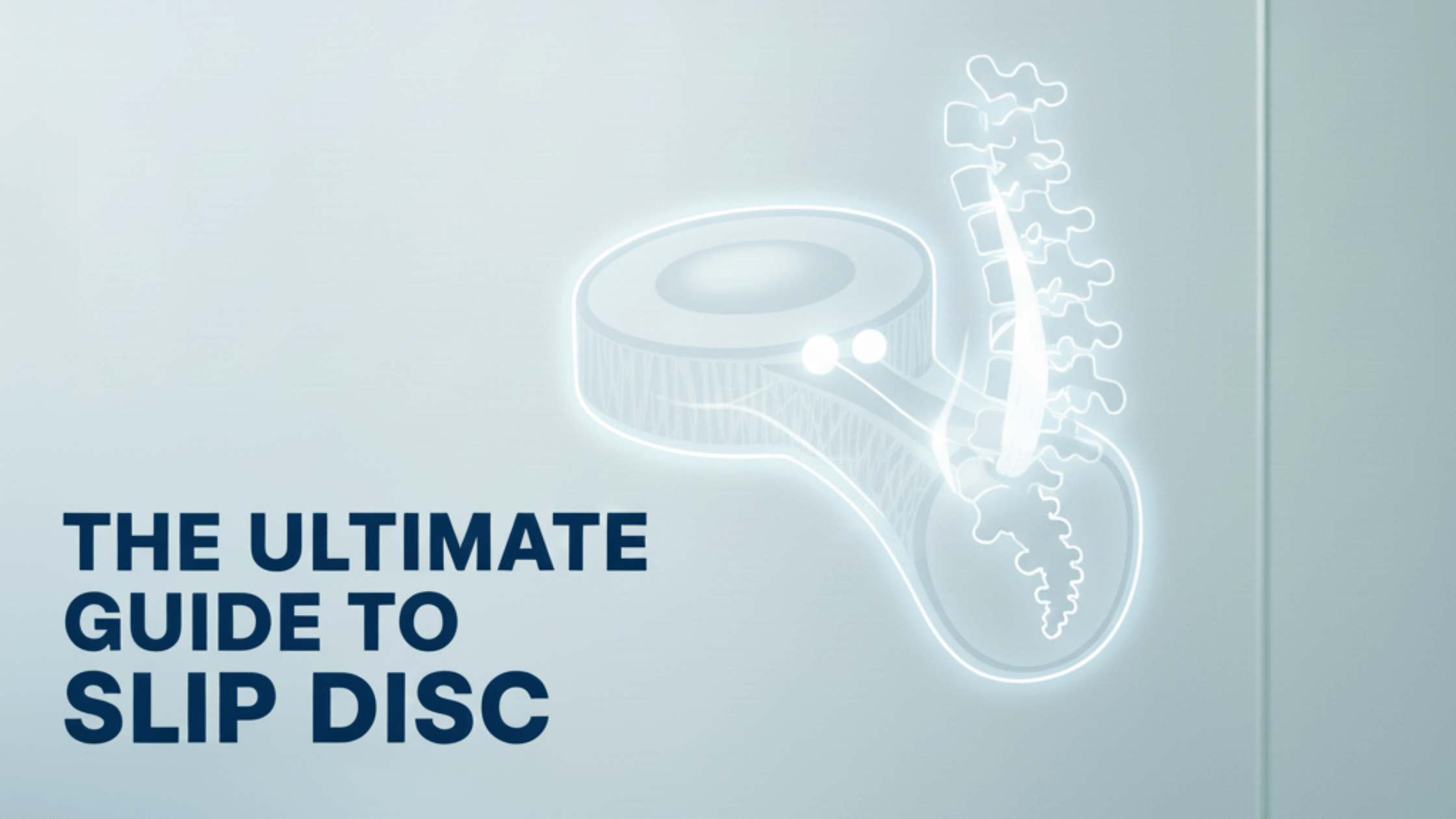
An In-Depth Exploration with Dr. Praveen Goparaju, Spine Surgeon
Back pain is often dismissed as a “part of life” or a consequence of aging. However, for millions of people, back pain is more than a dull ache it is a debilitating condition that radiates into the legs, causes numbness, and disrupts the very fabric of daily life. At Apex Spine Care, led by renowned spine surgeon Dr. Praveen Goparaju, we see patients every day who are struggling with these symptoms. The most common diagnosis? A Slip Disc.
In this extensive guide, we will break down everything you need to know about slip discs, from the microscopic anatomy of your spine to the latest minimally invasive surgical breakthroughs.
Part I: Understanding the Foundation of Spinal Anatomy
To understand a slip disc, one must first understand the “shock absorbers” of the human body. As Dr. Praveen Goparaju explains, the spine is a column of bones (vertebrae) stacked upon one another. In between these bones are the intervertebral discs.
1. The Role of the Disc
The disc is not just a cushion; it is a sophisticated mechanical structure. It allows for the incredible range of motion humans possess the ability to bend forward to tie a shoe, twist to look behind, and absorb the impact of running or jumping.
2. The Two-Part Structure
Dr. Praveen Goparaju highlights two critical components of the disc:
-
The Annulus Fibrosus: This is the tough, circular exterior. Think of it as a series of cross-linked collagen fibers that act as a “fence” or a containment wall.
-
The Nucleus Pulposus: This is the inner core, which has a jelly-like consistency. It is highly hydrated and responsible for distributing pressure evenly across the disc.
A “Slip Disc” occurs when the pressure on the Nucleus Pulposus becomes so great, or the Annulus Fibrosus becomes so weak, that the inner “jelly” pushes through the outer “fence.”
Part II: The Four Stages of Disc Degeneration
Medical terminology can be confusing. Many patients receive an MRI report and see words like “bulge,” “herniation,” or “sequestration” and feel overwhelmed. Dr. Praveen Goparaju categorizes these into four distinct stages:
1. Disc Bulge (Degeneration)
This is often the first stage of wear and tear. The disc doesn’t actually “slip”; rather, it flattens and extends slightly beyond its normal boundary. Interestingly, many people have disc bulges and feel no pain at all. It is a common finding in MRIs as we age.
2. Disc Herniation (Prolapse)
In this stage, the shape of the disc changes significantly. The Nucleus Pulposus begins to push into the weakened areas of the Annulus Fibrosus, creating a prominent “bump.” While the outer layer is still intact, this bump can begin to “pinch” the nerves exiting the spinal column.
3. Disc Protrusion (Extrusion)
This is a more serious stage. The soft inner material actually breaks through the outer layer but remains attached to the disc. This material often enters the spinal canal, where it can cause significant nerve compression. This is where patients begin to experience the classic “sciatica” pain a sharp, electric sensation running down the leg.
4. Sequestered Disc (The Emergency Stage)
As Dr. Praveen Goparaju notes, this is the most severe form. A piece of the disc material breaks off entirely and moves away from the disc into the spinal canal. This can lead to “Cauda Equina Syndrome” or severe nerve damage. If you experience sudden loss of bladder control or extreme weakness, this is a medical emergency that requires immediate intervention.
Part III: Symptoms When to See Dr. Praveen Goparaju
How do you know if your back pain is a simple muscle strain or a slip disc? Look for these “Red Flags”:
-
Sciatica: A traveling pain that starts in the lower back and moves through the buttock down to the calf or foot.
-
Numbness and Tingling: Often described as “pins and needles” or a “burning” sensation.
-
Muscle Weakness: Difficulty lifting your foot (foot drop) or feeling like your leg might “give out.”
-
Increased Pain While Sitting: Pressure on the discs is highest when sitting; if your pain worsens after 20 minutes of sitting, it’s likely a disc issue.
Part IV: Diagnosis and the Importance of MRI
At Apex Spine Care, diagnosis begins with a conversation. Dr. Praveen Goparaju conducts a thorough clinical evaluation, checking your reflexes and muscle strength.
However, the “Gold Standard” for diagnosis is the MRI (Magnetic Resonance Imaging).
-
Why MRI? Unlike X-rays, which only show bones, an MRI provides a 3D view of the soft tissues the discs, nerves, and ligaments.
-
The MRI “Trap”: Dr. Praveen Goparaju often cautions patients not to panic over an MRI report. Many people have “abnormal” MRIs but no pain. The goal of a great surgeon is to treat the patient, not just the report.
Part V: The Treatment Spectrum
Dr. Praveen Goparaju follows a conservative-first philosophy. Surgery is never the first option unless there is a risk of permanent nerve damage.
1. Conservative Management (The First 6 Weeks)
Over 80% of slip disc cases resolve without surgery.
-
Medication: We use anti-inflammatories to reduce the swelling of the nerve and neuropathic agents like Gabapentin or Pregabalin to “quiet” the nerve signals.
-
Physiotherapy: This is not just “stretching.” It involves core stabilization and “McKenzie exercises” that help centralize the pain back toward the spine and away from the legs.
-
Activity Modification: Learning how to sit, stand, and sleep in ways that take the pressure off the disc.
2. The Role of Spine Injections
For patients who are in too much pain to perform physiotherapy but aren’t ready for surgery, Epidural Steroid Injections can be a bridge.
-
How they work: A concentrated dose of anti-inflammatory medication is injected directly near the compressed nerve.
-
The Reality Check: Dr. Praveen Goparaju emphasizes that injections are a “window of opportunity.” They reduce pain so you can do the exercises necessary to heal the disc naturally.
3. Minimally Invasive Spine Surgery (MISS)
If pain persists after 6–12 weeks of conservative care, surgery is discussed. Gone are the days of massive incisions and long hospital stays.
-
Microdiscectomy: Using a high-powered microscope, Dr. Praveen Goparaju makes a tiny incision to remove only the fragment of the disc that is pressing on the nerve.
-
Endoscopic Spine Surgery: This is the pinnacle of modern spine care using a camera (endoscope) to perform the surgery through an incision smaller than a centimeter.
-
Benefits: Less blood loss, minimal scarring, and many patients are back on their feet the same day.
Part VI: Recovery and Life After Treatment
Recovery doesn’t end when the surgery is over or the pain stops. The goal is to prevent a recurrence.
1. The “Spine-Friendly” Lifestyle
-
Ergonomics: Your desk setup is vital. Ensure your monitor is at eye level and your lower back is supported.
-
Weight Management: Every extra kilogram of body weight puts four times that amount of pressure on your lower spine.
-
Core Strength: The “inner corset” of muscles (transverse abdominis) must be strong to take the load off your discs.
2. Post-Surgical Rehabilitation
After surgery with Dr. Praveen Goparaju, patients follow a structured “Return to Activity” plan. Walking is encouraged almost immediately, while heavy lifting is restricted for several weeks to allow the Annulus Fibrosus to scar over and heal.
Part VII: FAQs with Dr. Praveen Goparaju
Q: Will I become paralyzed if I have spine surgery?
A: This is a common myth. With modern navigation, microscopes, and neuromonitoring, spine surgery is incredibly safe. The risk of paralysis in a standard discectomy is extremely low.
Q: Can a slip disc heal on its own?
A: Yes! Through a process called “resorption,” the body’s immune system can sometimes recognize the herniated disc material as a foreign object and slowly dissolve it.
Q: When is surgery an emergency?
A: If you experience “Saddle Anesthesia” (numbness in the areas that would touch a horse saddle) or sudden loss of bowel/bladder control, you must seek help within 24 hours.
Conclusion: Take Control of Your Spine Health
A slip disc can feel like a life sentence, but it doesn’t have to be. With the expertise of Dr. Praveen Goparaju and the advanced technology at Apex Spine Care, we can help you navigate the journey from pain to performance.
Whether it’s through guided physical therapy, precision injections, or state-of-the-art minimally invasive surgery, our goal is to get you back to the life you love.
Don’t ignore the warning signs. Your spine is your support system give it the care it deserves.
