




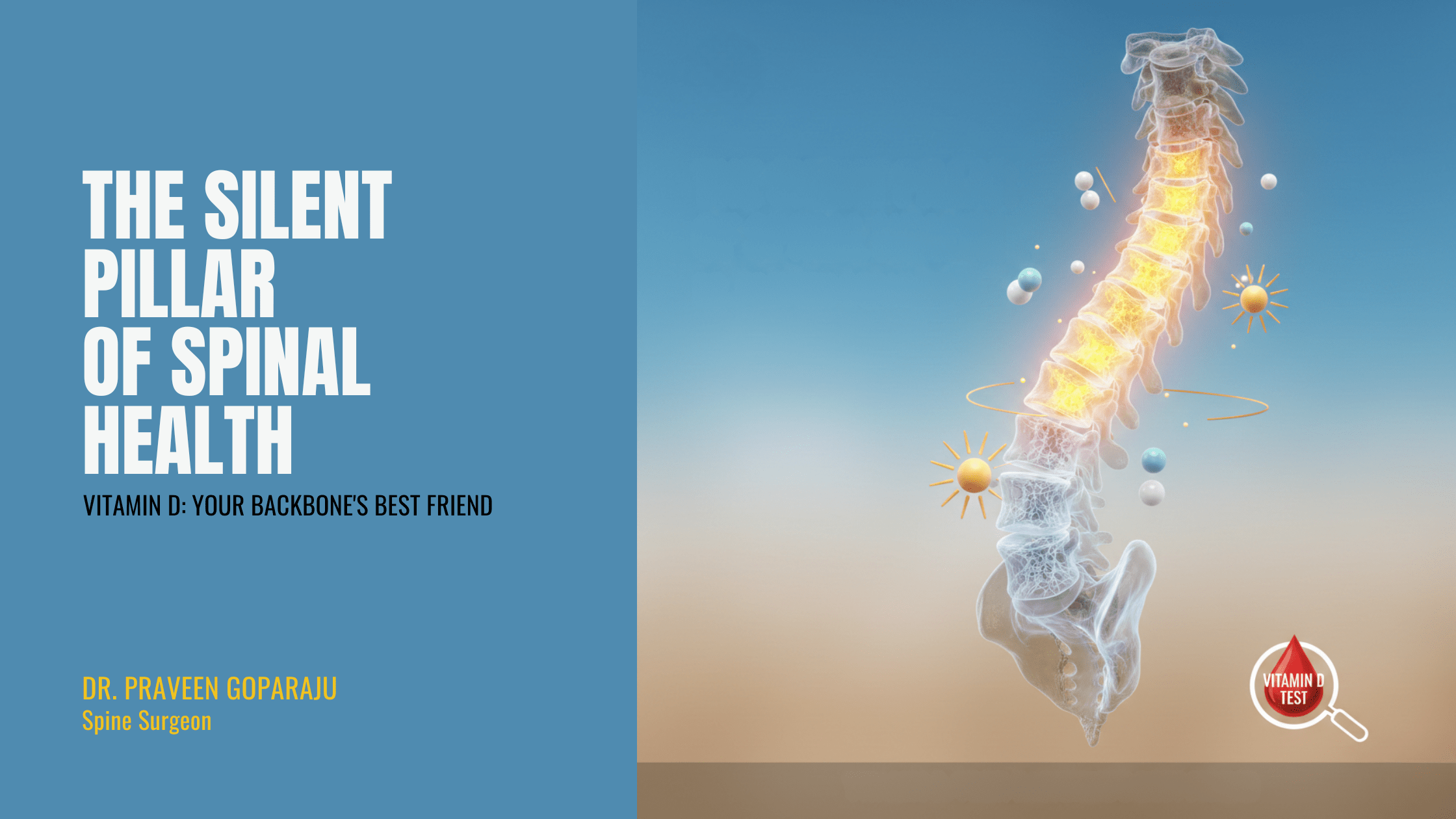
A Surgeon’s Comprehensive Guide to Vitamin D, Bone Density, and Back Pain
In the heart of Hyderabad, a city that gracefully blends its rich historical heritage with a bustling, high-tech future, a silent epidemic is unfolding within the walls of our modern offices and high-rise apartments. As a spine surgeon, my days are spent analyzing complex neural pathways and structural alignments. Often, patients arrive at my clinic clutching folders full of advanced imaging MRIs, CT scans, and high-resolution X-rays hoping that technology will pinpoint the exact source of their debilitating back or neck pain.
While these tools are invaluable, I find myself increasingly looking beyond the pixels of an MRI. I look at the chemistry of the human body. In a surprising number of cases, the “missing link” isn’t a physical trauma or a genetic deformity, but a profound deficiency in a single, fat-soluble nutrient: Vitamin D.
This guide is designed to be the definitive resource for understanding the intricate relationship between Vitamin D and your spine. We will explore why this “sunshine vitamin” is actually a powerful hormone, how it dictates the strength of your vertebrae, and why the modern lifestyle in cities like Hyderabad is making us more vulnerable to spinal degeneration than ever before.
1. Beyond the Label: Why Vitamin D is a Master Hormone
To understand why I insist on Vitamin D testing for my spine patients, we must first correct a common misconception. Vitamin D is not just a “vitamin” in the traditional sense; it is a secosteroid hormone. Unlike Vitamin C, which you must ingest through food, Vitamin D is something your body is designed to manufacture itself through an elegant biological process.
The Biological Alchemy of Synthesis
The journey begins on the surface of your skin. When ultraviolet B (UVB) radiation from the sun hits the skin, it interacts with a form of cholesterol called 7-dehydrocholesterol. This reaction produces Vitamin D3 (cholecalciferol).
However, this is only the beginning. This Vitamin D3 is biologically inactive. It travels through the bloodstream to the liver, where it undergoes its first transformation into 25-hydroxyvitamin D [25(OH)D]. This is the form we typically measure in blood tests to determine your “Vitamin D status.”
The final and most critical step happens in the kidneys. Here, an enzyme converts the precursor into the active, “hormonal” form: 1,25-dihydroxyvitamin D [1,25(OH)2D], also known as calcitriol.
The Gatekeeper of the “Calcium Economy”
Why does a spine surgeon care about this chemical pathway? Because calcitriol is the “key” that unlocks the door for calcium absorption in the intestines. Without adequate active Vitamin D, your body can only absorb about 10% to 15% of the calcium you consume.
The human body prioritizes blood calcium levels above almost everything else because calcium is required for the heart to beat and muscles to contract. If your blood calcium drops because your gut isn’t absorbing it, your body doesn’t just give up. It triggers the parathyroid glands to release hormones that “mine” calcium from your skeleton. Your spine, being a massive reservoir of bone tissue, becomes the primary target for this “mining” operation. Over months and years, this process leaves your vertebrae porous, soft, and structurally compromised.
2. The Hyderabad Paradox: Sun-Drenched but Deficient
One of the most frequent questions I hear in my practice is: “Doctor, we live in India. We have sun all year round. How can I possibly be deficient?”
This is the Hyderabad Paradox. Despite our geographical advantage, several factors are conspiring to keep our Vitamin D levels dangerously low:
The “Glass Box” Lifestyle
The rise of Hyderabad as an IT and corporate hub means that a vast majority of our workforce spends the peak “sunlight hours” (10 AM to 3 PM) inside climate-controlled buildings. Standard window glass blocks almost 100% of UVB rays. You might see the sun through your office window, but your skin isn’t receiving the specific wavelength required to trigger Vitamin D synthesis.
The Melanin Factor
As Indians, our skin contains higher levels of melanin, the pigment that protects us from skin cancer. While melanin is a natural sunscreen, it also competes with 7-dehydrocholesterol for UVB photons. This means that an individual with darker skin requires 3 to 5 times more sun exposure than someone with very fair skin to produce the same amount of Vitamin D.
Atmospheric Pollution
Rapid urbanization brings air pollution. Particulate matter and smog in urban centers can scatter and absorb UVB rays before they reach the ground. Studies have shown that residents in highly polluted urban areas have significantly lower Vitamin D levels compared to those in rural, clearer environments.
3. How Vitamin D Deficiency Reshapes the Spine
When we talk about the “spine,” we aren’t just talking about a single bone. We are talking about a complex architecture consisting of 33 vertebrae, dozens of joints, shock-absorbing discs, and a network of stabilizing muscles. Vitamin D deficiency acts like a slow-motion wrecking ball against this structure.
Osteomalacia: The “Soft Spine” Syndrome
In adults, a severe Vitamin D deficiency leads to Osteomalacia. Unlike Osteoporosis (where bones become brittle), Osteomalacia makes the bones “soft” because they aren’t properly mineralized.
Think of a vertebra like a brick. A healthy brick is hard and kiln-fired. An osteomalacic vertebra is like a brick made of wet clay. When you sit at a desk for eight hours or lift a heavy object, the “wet clay” vertebrae of your spine compress under the pressure. This leads to generalized, deep-seated aching in the lower back and pelvis that many patients mistake for simple muscle strain.
Cervical and Lumbar Spondylosis
Spondylosis is the medical term for age-related wear and tear. However, we are now seeing “premature spondylosis” in patients as young as 25. When the vertebral bones are weakened by low Vitamin D, the joints (facet joints) that allow your spine to move have to take on extra weight. This causes the cartilage to wear out faster, leading to inflammation, stiffness, and the growth of “bone spurs” (osteophytes). These spurs can then narrow the space where nerves exit the spine, causing radiating pain.
The Disc Connection and the Sciatica Risk
While the discs between your vertebrae are made of fibrocartilage, not bone, they are heavily dependent on the health of the “endplates” of the vertebrae they sit on. If the bone endplate is weak due to poor mineralization, the disc cannot receive the nutrients it needs via diffusion.
A “starved” disc becomes brittle and prone to cracking. Once the outer layer (annulus) cracks, the inner gel (nucleus) can leak out. This is a herniated disc. If this gel touches the sciatic nerve, the result is Sciatica—a sharp, electric shock sensation that travels from the back down to the leg. In my surgical experience, many “failed” conservative treatments for sciatica could have been avoided if the patient’s bone health had been addressed early through Vitamin D correction.
4. The Critical Role of Vitamin B12: The “Nerve Protector”
I cannot discuss spinal health without mentioning the “partner” to Vitamin D: Vitamin B12. In my Hyderabad clinic, I routinely order these tests together.
If Vitamin D is responsible for the “bricks and mortar” (the bones), Vitamin B12 is responsible for the “electrical wiring” (the nerves). B12 is essential for maintaining the myelin sheath, the insulating layer that surrounds your nerves.
When B12 is low, the “wiring” of your spinal cord and peripheral nerves starts to “short circuit.” This causes symptoms that perfectly mimic spinal disc problems:
-
Numbness or “pins and needles” in the hands and feet.
-
Burning sensations in the legs.
-
Loss of balance or a “wobbly” gait.
For vegetarians who make up a large portion of our population in Hyderabad B12 deficiency is incredibly common because the vitamin is primarily found in animal products. Treating a “back pain” patient often requires this dual approach: Vitamin D to strengthen the structure and B12 to heal the nerves.
5. Women’s Spinal Health: The Menopause Transition
Spinal health for women requires a specialized perspective. Throughout life, estrogen plays a protective role in maintaining bone density. However, as women approach and enter menopause, estrogen levels plummet.
When estrogen drops, the rate at which the body removes old bone increases. If this is compounded by a Vitamin D deficiency, the result is a rapid transition from Osteopenia (low bone mass) to Osteoporosis (fragile bones).
For women in their 40s and 50s, a “simple” fall in the bathroom or even a vigorous sneeze can lead to a vertebral compression fracture. These fractures often go undiagnosed, presenting only as a “hunching” of the back (kyphosis) and chronic mid-back pain. Ensuring Vitamin D sufficiency before menopause is one of the best “pension plans” a woman can have for her spinal health.
6. Recognizing the “Whisper” Symptoms
As a surgeon, I often see patients when the “whisper” has become a “scream” when the pain is so bad they can no longer walk or work. My goal is to help you hear the whispers of Vitamin D deficiency before structural damage occurs.
1. The “Heavy” Back
Does your back feel “tired” or “heavy” by 2:00 PM? This is often a sign that your vertebrae and supporting muscles are struggling to hold your frame against gravity due to poor mineralization.
2. Muscle Twitches and Cramps
Vitamin D is essential for muscle fiber function. Deficiency can lead to “hypocalcemic irritability” in the muscles, causing unexplained twitching, eyelid fluttering, or nocturnal leg cramps.
3. Persistent Fatigue
If you feel exhausted despite sleeping well, your body may be struggling with the metabolic cost of trying to maintain calcium homeostasis without enough Vitamin D.
4. Sweaty Scalp
Interestingly, one of the classic (though often overlooked) signs of Vitamin D deficiency is a sweaty forehead or scalp, even when the rest of the body is at a comfortable temperature.
7. The Surgeon’s Protocol: Prevention and Correction
If you suspect you are deficient, or if you are already suffering from spinal issues, how do we fix the foundation?
Step 1: Accurate Testing
Don’t guess; test. A simple blood test for 25-Hydroxy Vitamin D is the gold standard.
-
Deficient: Below 20 ng/mL
-
Insufficient: 20 to 30 ng/mL
-
Optimal: 40 to 60 ng/mL
In my practice, for patients recovering from spine surgery, I aim for the “Optimal” range to ensure the fastest possible bone healing.
Step 2: The Sunlight Strategy
You don’t need to spend hours in the sun. The “Shadow Rule” is a great guide: if your shadow is shorter than you are, the sun is high enough to produce Vitamin D.
-
Duration: 15–30 minutes.
-
Exposure: Arms, face, and legs should be uncovered.
-
Timing: 11:00 AM to 1:00 PM is most effective in Hyderabad.
Step 3: Nutrition
While food alone usually can’t correct a deep deficiency, it helps maintain levels. Focus on:
-
Fatty Fish: Mackerel (Bangda) and Salmon.
-
Egg Yolks: Don’t skip the yolk; that’s where the Vitamin D lives.
-
Mushrooms: Specifically those grown in sunlight or UV light.
-
Fortified Foods: Some milks and cereals are fortified, but check the labels for “D3” (cholecalciferol) rather than “D2” (ergocalciferol), as D3 is more effective.
Step 4: Therapeutic Supplementation
For many of my urban patients, supplements are a necessity.
-
Initial Correction: We often use high-dose weekly “pulses” (e.g., 60,000 IU) for 8 to 12 weeks.
-
Maintenance: A daily dose of 1,000 to 2,000 IU is often recommended for those with limited sun exposure.
A Warning from the Surgeon: Vitamin D is fat-soluble. Unlike Vitamin C, which you simply pee out if you take too much, Vitamin D stays in your fat tissues. Taking extreme doses without medical supervision can lead to Vitamin D Toxicity, which causes calcium to build up in your blood, potentially leading to kidney stones or heart rhythm issues. Always follow a doctor’s prescription.
8. Why This Matters for Your Long-Term Mobility
As a spine surgeon, my ultimate goal is to keep you active, mobile, and independent well into your later years. Surgery is a powerful tool, but it is a “repair” job. The highest quality of life comes from maintaining the “original parts” of your spine in peak condition.
When your Vitamin D levels are optimized:
-
Surgery Outcomes Improve: If surgery is necessary, your bones will hold onto screws and implants much more securely if they are dense and healthy.
-
Recovery is Faster: Vitamin D reduces systemic inflammation, helping you bounce back from back strains or surgical procedures more quickly.
-
Balance is Better: Studies show Vitamin D improves the “proprioception” (spatial awareness) of your muscles, which prevents the falls that lead to spinal fractures.
Conclusion: A Call to Action for Every Hyderabadi
We live in a world that demands a lot from our bodies. We sit for long hours, we carry heavy stress, and we navigate a fast-paced urban environment. Your spine is the literal “backbone” of your ability to meet these demands.
Do not allow a silent, easily correctable deficiency to compromise your future mobility. If you are experiencing persistent neck pain, lower back aches, or that nagging sense of fatigue, the answer might not be a more expensive office chair or a more aggressive workout routine. The answer might be as simple as a blood test and a little more time under the sun.
At my practice in Hyderabad, we believe in Holistic Spinal Care. We combine the precision of minimally invasive surgery with the foundational power of nutritional science. Let’s work together to ensure your spine is as strong, resilient, and vibrant as the city we call home.
Is it time for a check-up? If you have questions about your spinal health or wish to have your vitamin levels and spinal integrity evaluated, I invite you to visit our clinic. Let’s build a stronger foundation for your life, one vertebra at a time.
Dr. Praveen Goparaju Spine Surgeon | Hyderabad Specializing in Endoscopic & Minimally Invasive Spine Surgery Dedicated to the Science of Movement and the Art of Healing
